
Table of Contents
Summary
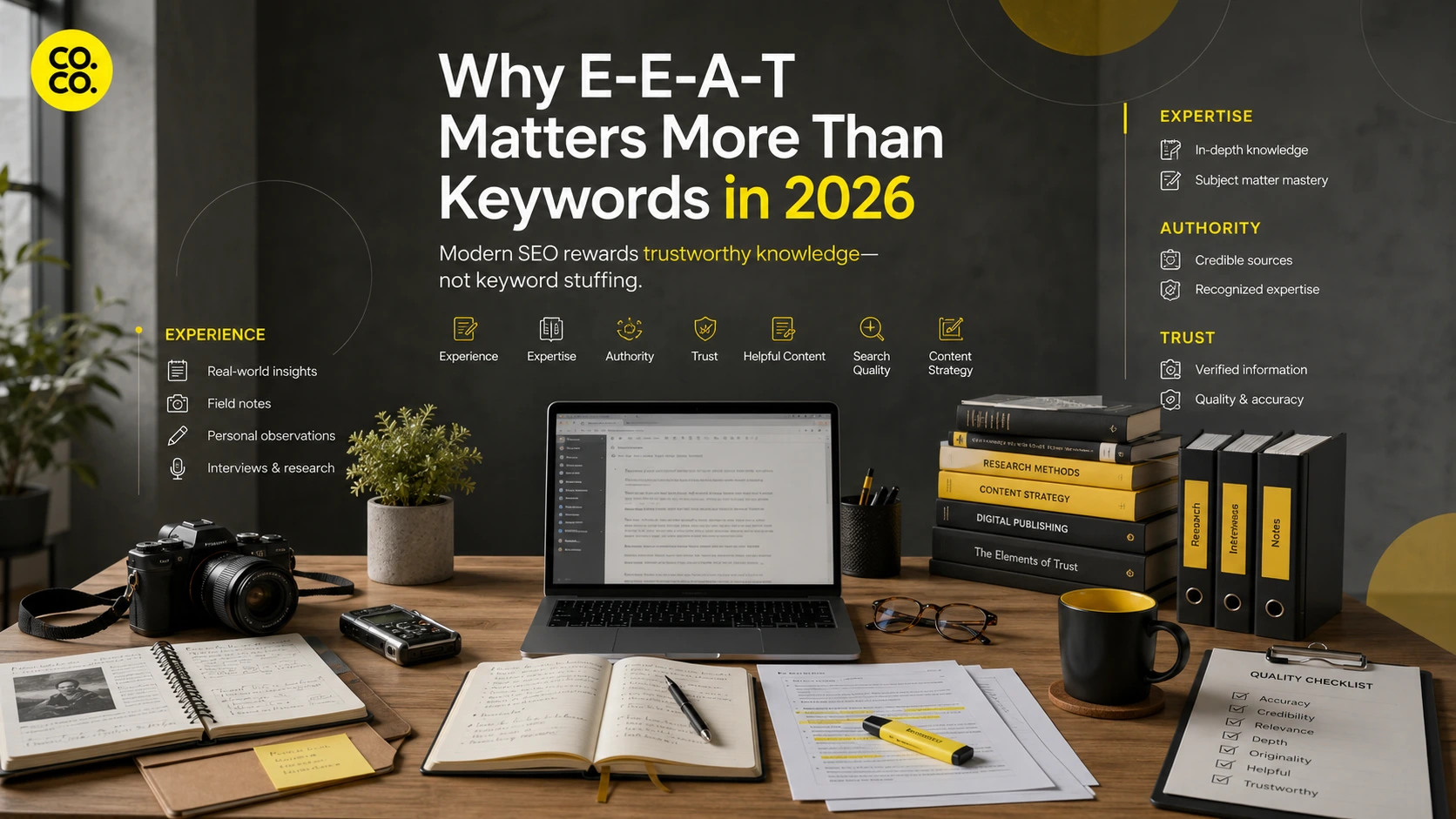
Keywords used to be the whole game in SEO. Not anymore. In 2026, Google is actively pushing down pages that look optimized but lack any real human expertise behind them, while rewarding content that shows genuine experience, credibility, and trust.
This shift, called E-E-A-T, decides which pages get cited in AI Overviews and which ones quietly disappear from the top results. This blog breaks down what E-E-A-T actually means, why this year has made it unavoidable, and shows a real example of weak versus strong E-E-A-T in action. It also covers practical steps small brands and agencies can use to build trust signals without needing a big budget or years of history behind them.
Key Takeaways
- Keywords still matter, but they only get your content noticed, not trusted. E-E-A-T decides whether Google surfaces it
- E-E-A-T stands for Experience, Expertise, Authoritativeness, and Trustworthiness, and it comes from Google’s Search Quality Rater Guidelines, not a direct ranking algorithm
- The flood of AI generated content since 2022 has made genuine first-hand experience rare, which is exactly why Google now rewards it more heavily
- Pages with strong E-E-A-T signals are significantly more likely to get cited inside AI Overviews and other AI search features
- Small brands can build E-E-A-T without a big budget through real author bios, honest client proof, genuine external mentions, and regularly updated content
- A simple checklist, named authors, visible dates, real examples, transparent contact details, and external recognition, can meaningfully strengthen how trustworthy a page appears
Why E-E-A-T Matters More Than Keywords in 2026
Last reviewed: August 2026
A page can be perfectly optimized with every keyword in the right place and still sit on page three of Google. That sentence alone breaks a rule most businesses have followed for over a decade. Search Engine Land calls this exact shift one of the biggest changes shaping SEO right now, and Ahrefs has gone as far as mapping over 220 individual signals Google appears to weigh when deciding who to trust. None of those signals are keywords.
Something bigger is happening. Since 2022, when Google quietly added a second “E” for Experience to its quality guidelines, the internet has been flooded with AI-generated content that reads well but says nothing new and comes from no one in particular. Google noticed. Its Helpful Content System now actively pushes down pages that look optimized but lack any real human behind them, and its AI Overviews are pulling answers almost exclusively from sources that show genuine expertise and credibility.
This is called E-E-A-T, short for Experience, Expertise, Authoritativeness, and Trustworthiness. And in 2026, it has quietly become more decisive to your rankings than the keywords you spent hours researching.
This article breaks down exactly what E-E-A-T means, why this year specifically has made it unavoidable, what it actually looks like on a real page, and how even a small brand or agency with no big budget can start building it today.
What Is E-E-A-T, Explained Simply
E-E-A-T stands for Experience, Expertise, Authoritativeness, and Trustworthiness. It comes from Google’s Search Quality Rater Guidelines, a body of documentation human reviewers use to judge whether content deserves to rank well. It is not a direct algorithm you can switch on. Instead, it is a framework that shapes how Google trains its systems to recognize quality content.
Experience
Means the person writing the content has actually done the thing they are writing about. Someone reviewing a product should have used it. Someone writing about running a business should have actually run one.
Expertise
Means the content shows real depth and understanding, not just surface level facts anyone could copy from another website.
Authoritativeness
Means other trusted sources recognize you as knowledgeable in your field. You cannot claim this about yourself. It has to be earned through mentions, links, and reputation.
Trustworthiness
Means your content is accurate, your website is safe to use, and you are transparent about who you are and what you offer.
Is E-E-A-T Actually a Google Ranking Factor
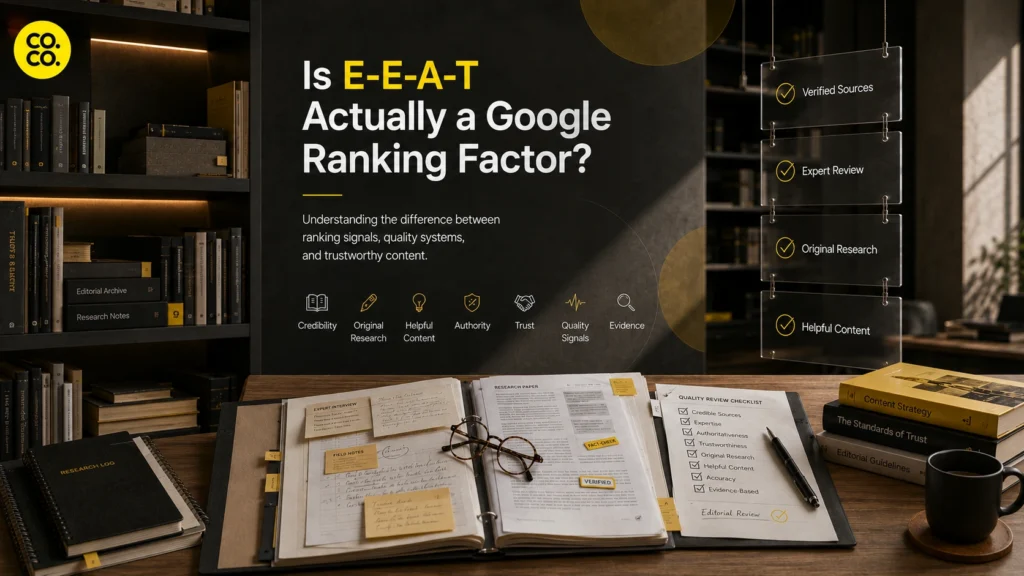
This is one of the most common questions people ask, so let us answer it directly. According to Semrush’s breakdown of E-E-A-T, it is not a single ranking signal Google flips on or off. It is a quality framework. Google’s algorithms are built to reward the same qualities that human quality raters look for. So while there is no single E-E-A-T switch, content that shows real experience and trust naturally performs better across almost every recent Google update.
Why 2026 Is Different
SEO experts have been talking about E-E-A-T since 2022, so why does it suddenly matter so much more now. The honest answer comes down to one big shift. Artificial intelligence tools have made it incredibly easy to produce content at scale. Anyone can generate a blog post in seconds. This has flooded the internet with content that sounds fine but says nothing new and comes from nowhere.
Google’s Helpful Content System was built specifically to catch this pattern. Pages that are optimized for search engines but do not reflect real human experience are being pushed down, even if they are technically well written. At the same time, AI Overviews and other AI powered search features are choosing which sources to trust and quote. According to Ahrefs’ research on E-E-A-T signals, pages showing strong experience and credibility markers are far more likely to get pulled into these AI generated answers.
In simple terms, keywords help Google understand what your page is about. E-E-A-T helps Google decide if your page deserves to be trusted enough to show people.
E-E-A-T Versus Keywords, What Actually Wins
Think of it this way. Keywords get you into the race. E-E-A-T decides how close you get to the finish line.
If your content does not include the right words and phrases people are searching for, Google may never understand what your page is about in the first place. That part has not changed. But once your page is relevant, Google then looks at signals of trust and expertise to decide who deserves the top spots. A page with perfect keyword placement but no real author, no real experience, and no supporting proof can still lose to a shorter, simpler page written by someone with genuine expertise.
This is exactly why some very well optimized websites still struggle to rank in 2026, while smaller, honest, well written pages are climbing past them.
A Real Example, Weak Versus Strong E-E-A-T
Let us look at what this actually looks like in practice, using a real style example.
A weak version of a blog post might look like this. No author name is shown. There is no date, so readers do not know if the advice is current. The claims are generic, things like “branding builds trust” with no example behind them. There is no mention of any real client or project.
A strong version of the same post adds a named author with a real role, for example a content strategist who has worked on actual branding projects. It includes a visible published or updated date. It references a specific real example, such as helping a jewelry brand build a more consistent visual identity across its website and social channels, without needing to expose private client details. It links out to other real service pages so readers can see the wider expertise behind the content.
This is a pattern we follow closely in our own work at COCO. When we publish content or build brand strategies for clients, we focus on showing real project experience rather than generic claims, because that is what earns trust with both readers and search engines.
How Small Brands and Agencies Can Build E-E-A-T Without a Big Budget

Many articles on this topic are written for large companies with big teams and big budgets. Most small businesses do not have that luxury, so here is how you can build E-E-A-T realistically.
Add real author bios to every piece of content. Include the person’s actual role and real experience, not vague titles.
Use your real client work as proof, even if you keep details anonymous. A short mention like “we helped a real estate client build a content plan that increased inquiries” is far stronger than no example at all.
Try to get mentioned on other relevant websites, even small local blogs, partner sites, or industry directories. Every genuine mention builds authority over time. Fractl’s research on author bios found that a credible bio can noticeably influence how both readers and quality raters judge a page.
Keep your contact details, business information, and policies clearly visible on your website. This is one of the simplest trust signals and most small websites skip it.
Go back and update your older content instead of only publishing new posts. An old, outdated post left untouched actually damages trust more than people realize.
A Simple Author Bio Template You Can Use Today
If you are not sure how to write a strong author bio, here is an easy template you can fill in.
Name is Role at Company, with number of years or number of projects experience in specific niche. They have worked on specific real project type, including one brief real example.
For example: Ananya is a content strategist at COCO, with over five years of experience in brand storytelling. She has worked on content strategies for jewelry, wellness, and real estate brands, helping them build clearer messaging across their websites and social channels.
A second example for someone earlier in their career: Rohan is a digital marketing associate at COCO, with two years of experience running social media campaigns for D2C brands. He recently helped a dry fruits brand grow its Instagram engagement through consistent content planning.
The E-E-A-T Checklist for 2026
Here is a simple checklist you can run through before publishing anything.
Does the post have a real named author with a real bio.
Is there a visible published or last updated date.
Does the content include at least one specific, real example or fact, not just general statements.
Is your business contact information clearly visible on the website.
Do other relevant websites mention or link to you.
Does the content fully answer what the reader actually came looking for, not just repeat keywords.
Is E-E-A-T Overhyped, Addressing the Pushback
Not everyone agrees that E-E-A-T is a big deal. Some experienced SEO professionals, as noted in Search Engine Land’s coverage of SEO in 2026, point out that search has seen many predicted revolutions before, including voice search and passage indexing, and most of them did not change the industry as dramatically as expected. It is a fair point worth taking seriously.
But there is one real difference this time. The scale of AI generated content on the internet today is unlike anything search engines have dealt with before. When almost anyone can produce large amounts of generic content instantly, genuine experience and real trust become far more rare, and far more valuable. Keywords, clean website structure, and solid technical SEO still matter and always will. They are simply no longer enough on their own to guarantee strong rankings.
Frequently Asked Questions
Is E-E-A-T a direct Google ranking factor
No, it is a quality framework, not a single ranking signal. But it strongly shapes what Google’s systems are trained to reward.
Do I need to show my real name and photo to rank well
You do not need a photo, but using a real name and honest bio makes a noticeable difference in how trustworthy your content appears.
Can AI generated content still rank in 2026
Yes, as long as it is reviewed, fact checked, and published under a real, credible author. Fully automated content with no human review or real experience behind it struggles the most.
How long does it take to build E-E-A-T for a new website
There is no fixed timeline. It builds gradually through consistent, honest content, real client proof, and genuine mentions from other trusted sources.
Does E-E-A-T apply to every industry or just sensitive topics
It applies everywhere, but it matters most for industries like health, finance, and legal advice, where Google holds content to a much higher standard.
Conclusion
Keywords will always help Google understand what your content is about. But in 2026, trust and real experience decide who actually earns the top spots and gets featured inside AI generated answers. The brands that win are not always the biggest ones. They are the ones willing to show real proof of who they are and what they know.
If you are looking to build a content strategy that focuses on real trust and long term growth rather than shortcuts, our team at COCO helps brands do exactly this every day. You can explore our content marketing and branding services, or get in touch to see how we approach it for real clients.