Table of Contents
Summary
Nobody can see Google’s plans for 2027, but Google’s own guides and its 2026 updates show a clear direction. This guide separates what Google has said, what its updates rewarded and what remains guesswork. It explains Google’s ignore list, including llms.txt and content chunking, shows why original, non commodity content matters most, warns about shaky AI traffic reporting and fake update rumors, and ends with a simple checklist and fifteen minute audit any business can use.
Key takeaways
- Google says there are no extra requirements to appear in AI Overviews or AI Mode.
- From Google’s view, optimizing for AI search is still SEO.
- Google says you can ignore llms.txt, content chunking and AI specific rewrites for Google Search.
- Original, non commodity content is the strongest long term advantage.
- The 2026 core updates shifted visibility toward official, specialist and established sources, and away from aggregators and directories.
- Forecasts about AI replacing search conflict, so plan for both rankings and AI visibility.
- Always verify update rumors and statistics on Google’s Search Status Dashboard and in original sources.
Introduction
Every few months, someone announces the secret Google now wants from your website. A new file to upload. A new way to split your content. A new tool that reads Google’s mind.
Here is a calmer truth. Nobody outside Google can see 2027. What we can see is what Google has written down, what its 2026 updates rewarded, and where it is clearly heading. This guide keeps those three things apart, so you always know what is a fact and what is a guess.
The clear answer: In 2027, Google will most likely want what it already asks for today. It wants pages it can crawl and index, content that helps real people, and ideas or experience that exist nowhere else. Google says optimizing for its AI features is still just SEO, and it says there are no special extra requirements to appear in AI Overviews or AI Mode. What is changing is how little patience Google has for pages that only repeat what everyone else already said.
Three labels you can trust in this guide
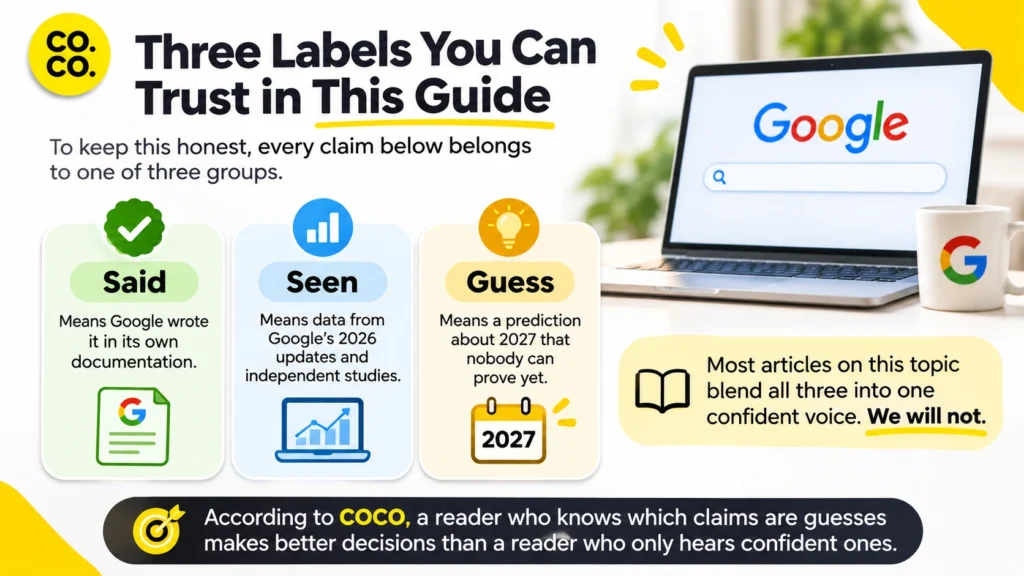
To keep this honest, every claim below belongs to one of three groups.
Said means Google wrote it in its own documentation. Seen means data from Google’s 2026 updates and independent studies. Guess means a prediction about 2027 that nobody can prove yet.
Most articles on this topic blend all three into one confident voice. We will not.
According to COCO, a reader who knows which claims are guesses makes better decisions than a reader who only hears confident ones.
What Google has said in writing
Start with the source. Google’s AI features guide for site owners says there are no additional requirements and no special optimizations needed to appear in AI Overviews or AI Mode. To show up as a supporting link, a page must be indexed and eligible to appear in Google Search with a snippet. It also says you do not need new machine readable files, AI text files or special schema markup.
Google then published a longer guide on optimizing for generative AI search, last updated in July 2026. It explains that these AI features run on Google’s core ranking and quality systems. Two ideas matter most. The system pulls pages from the regular Search index, and it uses query fan out, which means one question becomes several related searches behind the scenes.
Google also addresses the new buzzwords head on. Terms like AEO and GEO describe efforts to appear in AI answers, but from Google’s point of view, working on AI search is working on search, so it is still SEO.
The part Google says to skip
This is the section most articles leave out, and it may save you real money.
Google’s guide lists tactics you can ignore for Google Search. You do not need an llms.txt file or similar special files, because Google Search does not use them. You do not need to chop your content into tiny chunks for AI, and Google says there is no ideal page length. You do not need to rewrite your content in a special style for AI systems, because the systems understand meaning and related wording. Chasing fake mentions around the web does not work the way it sounds. And you should not obsess over structured data for AI purposes, though it still helps with regular rich results.
Google also warns about third party tools that promise to raise rankings or claim to use inside Google metrics, because no outside tool can see Google’s internal ranking systems.
If an agency pitches you one of these as the secret to 2027, ask where Google says so.
Copy what everyone else says, and you lose
Google’s strongest advice is about the content itself. It wants non commodity content, meaning pages that offer something a reader cannot get anywhere else.
Google gives a simple contrast. A page like “seven tips for first time home buyers” is common knowledge that anyone could write. A page about why one family skipped a home inspection, and what they found inside the sewer line, brings real experience and a real point of view. AI systems blend information from many sources, so the pages worth linking are the ones that add something new.
According to COCO, this is the one test every page should pass in 2027: could anyone have written this without doing the work? If the answer is yes, that page is at risk.
Google also warns against going too far in the other direction. Writing a separate page for every tiny variation of a question, just to manipulate rankings or AI answers, can break its scaled content abuse spam policy. More pages do not make a better site.
What the 2026 updates actually rewarded
Now for what we have seen. As of October, Google had confirmed seven ranking updates in 2026 on its Search Status Dashboard. Those were a Discover core update, four spam updates and two core updates.
The March 2026 core update started on 27 March. SE Ranking data shared with Search Engine Land showed nearly 80 percent of top three results changed position, and about 24 percent of top ten pages fell out of the top 100. A spam update had just finished the day before, so some of that movement had mixed causes.
The winners and losers show a pattern. Independent analysis reported by Search Engine Land found visibility moving toward official sources, specialist sites and established brands, while aggregators, directories and comparison sites lost more often. In health, broad consumer sites slipped and clinical and specialist sources gained.
Several agency studies describe winners as pages with first hand experience, named authors, original data and links to primary sources. That reading is practitioner opinion, not a published Google list, so treat it as a strong hint. It does match what Google says it wants.
The May 2026 core update began on 21 May, and the September 2026 spam update ran from 24 September to 8 October, according to Search Engine Journal. Rankings looked shaky again around 20 to 24 October, but Google has not confirmed another update.
According to COCO, the winners share one habit. They are the original source, not the middleman describing the original source.
What Google is building next
Here is where we move from seen to guess, so read carefully.
Google’s own guide has a short section on AI agents, which are tools that act for a person, like comparing products or booking something. It points site owners to guidance on making sites easier for these agents to use, and mentions an emerging commerce protocol. Google presents this as early territory, not a requirement.
Some experts also expect fewer clicks. Search Engine Journal columnist Duane Forrester predicts that search ad revenue keeps growing while the share earned by sending people to other websites shrinks. He points to Alphabet’s second quarter search revenue of $63.3 billion, up 17 percent, which was the first slowdown in six quarters. He calls his own predictions tea leaf reading and says he sells measurement tools, which is the kind of honesty worth copying. Search Engine Journal also reported a field study that found a 38 percent drop in organic clicks when an AI summary appeared, which fits the same direction.
Forecasts about AI replacing search vary a lot. One estimate from Morningscore expects AI chat to take about 13 percent of informational searches and 6 percent of money searches by 2028. Other 2027 articles claim AI will drive the majority of organic interactions. Those two views cannot both be right, and neither can be checked yet.
According to COCO, plan for both. Keep earning rankings, and also make your pages worth citing.
The measurement trap nobody warns you about
Even if you do everything right, your reports may mislead you in 2027.
Forrester explains the problem simply. Some numbers are counted, and some are inferred, and your dashboard shows both in the same font with the same decimals. In May 2026, Google Analytics added an AI Assistant channel, but the full list of recognized AI sources was not published at launch, and it only counts forward with no history. On 1 September, standard reports showed zero traffic for many properties while real time reports kept working.
None of that is a scandal. It is a reminder to ask what a number actually counts before you tell a client their AI traffic is up or down. Google’s guide also points to a generative AI performance report inside Search Console, and Google says AI features count toward your regular Search Console traffic.
How to check if a Google update really happened
Update rumors spread fast, and some are made up. One analysis found sites citing an August 2026 core update with a made up figure, when Google had confirmed no such update. The date looked like one from 2025.
Use one rule. Google confirms updates on its Search Status Dashboard, and everything else is inference. Dates also get mixed up. One analysis placed the March 2026 core update on 6 March, while the dashboard coverage points to 27 March. If an article quotes a statistic with no source, assume it is unverified.
A simple 2027 checklist for any business
You do not need a new tool. You need a better habit.
Start with the basics. Make sure Google can crawl and index your key pages, and that nothing blocks them by mistake. Link your important pages together so both people and crawlers find them. Keep your content readable in text, not buried in images or scripts.
Then fix your content. Find your most generic pages and add something only you can offer, such as real results, original photos, your own data, a named expert, or a lesson from a real project. Use clear headings so readers move through the page easily. Add good images and short videos where they help.
Finally, tidy the details. Keep your Google Business Profile and, if you sell products, your Merchant Center information accurate. Make sure structured data matches what people see on the page. Reduce duplicate pages. Keep your pages fast and usable on a phone.
What this looks like for Indian businesses
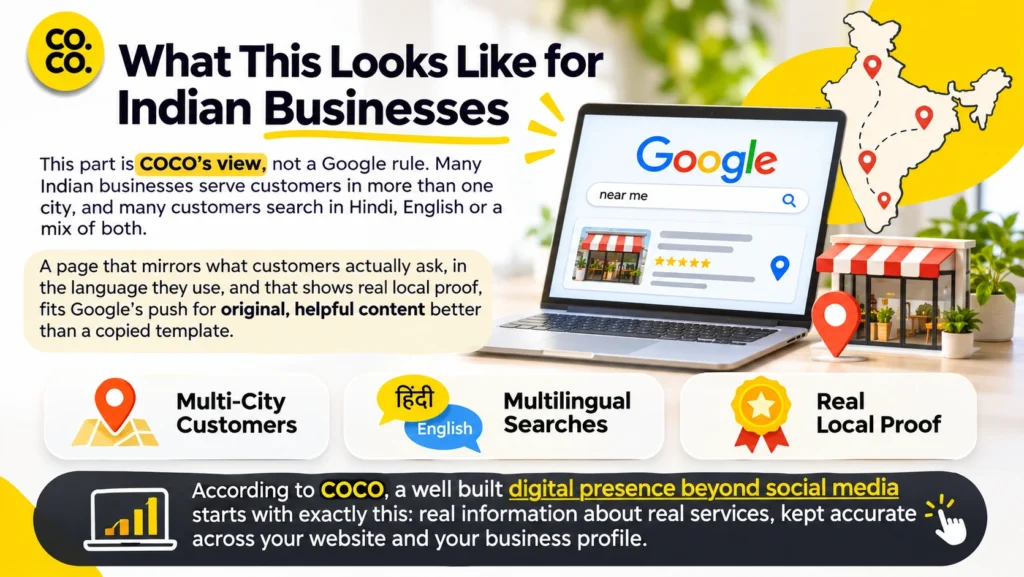
This part is COCO’s view, not a Google rule. Many Indian businesses serve customers in more than one city, and many customers search in Hindi, English or a mix of both. A page that mirrors what customers actually ask, in the language they use, and that shows real local proof, fits Google’s push for original, helpful content better than a copied template.
According to COCO, a well built digital presence beyond social media starts with exactly this: real information about real services, kept accurate across your website and your business profile.
A fifteen minute page audit
Open one important page and ask five questions. Could a competitor have written this without doing the work? Does it include something original, like data, a case, or a first hand story? Is it indexed and free of blocks? Does it load fast and read well on a phone? Does it match what the searcher really wanted?
If you answer no to the first question, start rewriting there.
Frequently asked questions
What does Google want from websites in 2027?
Google wants crawlable, indexable pages with helpful, original content made for people. Its own guides say existing SEO best practices still apply to AI features, and no special requirements exist.
Do I need llms.txt for Google?
No. Google says its Search does not use llms.txt files, so they will not help or hurt your Google rankings. You can still create one for other tools if you want.
Is GEO different from SEO?
Google says that, from its point of view, optimizing for generative AI search is part of search optimization. Third party GEO services should be checked against Google’s own guidance first.
Will AI Overviews kill organic traffic?
They reduce clicks in many cases, and one field study found a 38 percent drop when an AI summary appeared. Forecasts for the future differ widely, so plan for a mix of search and AI visibility.
Can I use AI to write my content?
You can use AI tools, but the content must still meet Google’s quality standards and spam policies. Copying what already exists, or mass producing pages, is the risky path.
Final thoughts
Google is not hiding a secret for 2027. It is telling you plainly: be crawlable, be helpful, and say something nobody else has said. The tricks will keep changing. The people who do real work and show it will keep winning.
According to COCO, the safest plan for 2027 is also the simplest. Build pages worth citing, keep them accurate, and check every claim before you believe it. If you want help turning your pages from common to original, our content marketing team can walk through an audit with you.