
Table of Contents
Summary:
Topical clusters are a content structure built around one pillar page and several connected supporting pages, a model that HubSpot created in 2017 rather than Google. This guide explains where the idea actually came from, addresses Google’s own pushback on the term topical authority, and separates traceable case study numbers from unsourced claims floating around online. It also covers why this structure matters more now because of AI search tools, and how Indian businesses covering multiple cities can build real clusters instead of thin, templated location pages.
Key takeaways:
- Topical clusters were invented by HubSpot in 2017, not by Google.
- Google’s own John Mueller has said there is no official topical authority score or label.
- Clustering still works because it naturally supports real signals, like E-E-A-T authoritativeness and avoiding duplicate, competing pages.
- Many quoted lift percentages online are unsourced and contradict each other.
- HubSpot’s own named case studies show real, traceable growth from the model, though they reflect one company’s results.
- AI search tools favor sources with real topical depth, making clusters more relevant now than when the model started.
- Indian businesses building city or region based clusters need genuinely distinct content per page, not a reused template.
Introduction
You have probably heard the phrase thrown around in every SEO meeting lately. Build topical clusters. Show Google your authority. Dominate the topic, not just the keyword.
But what does any of that actually mean, and is it true?
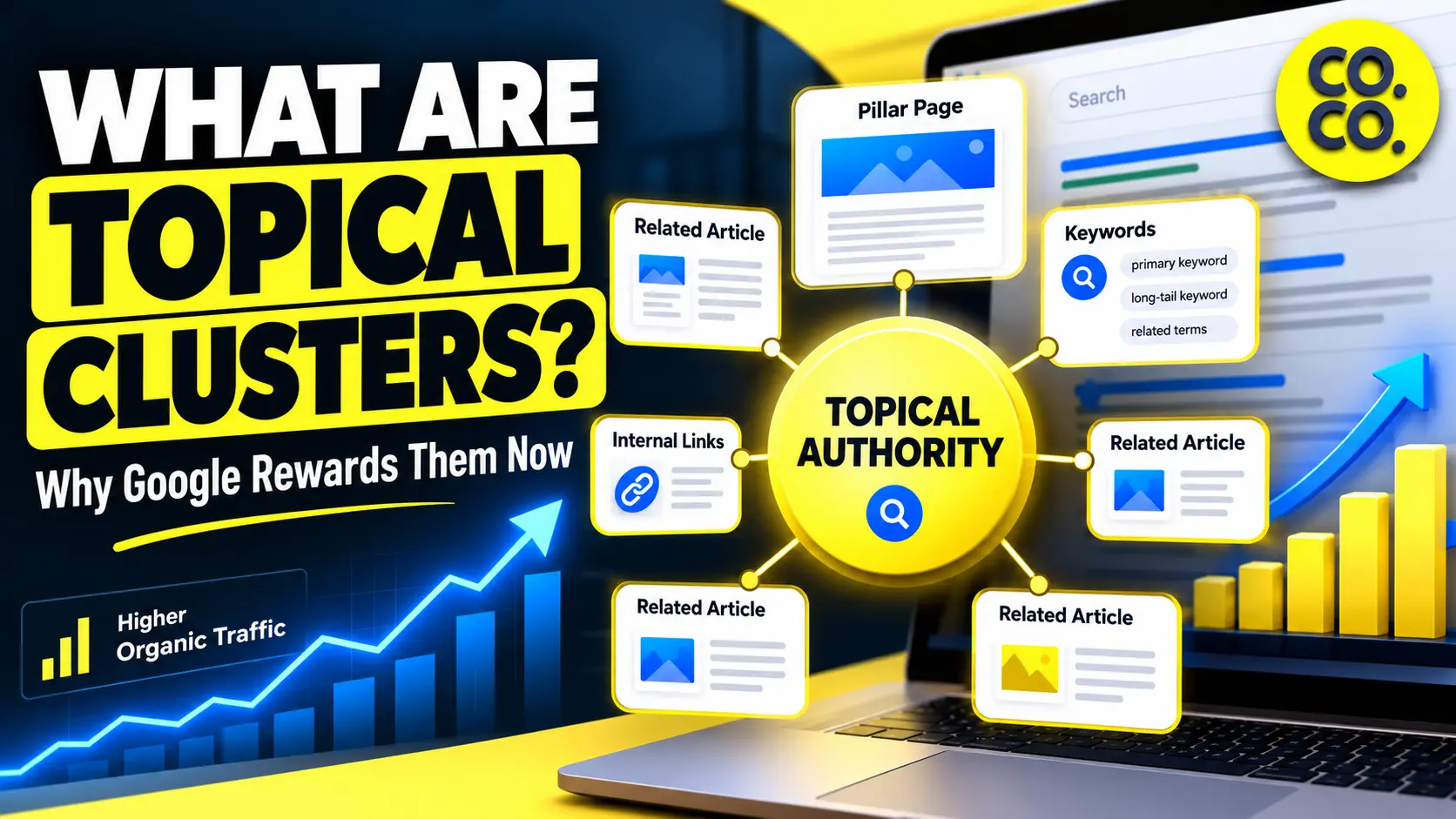
The clear answer: a topical cluster is a way of organizing your website content around one central page, called a pillar page, surrounded by several smaller pages that each dig into one specific part of that topic, all linked together. Google does not literally hand out an authority badge for building one. What really happens is that clustering your content naturally satisfies the real signals Google does look for, like depth of expertise and a site that is not fighting itself with repeated, overlapping pages. That distinction matters more than most articles on this topic let on, and it is exactly the kind of structural thinking behind our own content marketing work.
Where this idea actually came from
Here is something almost nobody tells you. Topical clusters were not invented by Google. They were invented by HubSpot, the marketing software company, back in 2017. The original post laid out the model using content marketing as the example topic with sixteen smaller pages built around it, and you can see the full breakdown of HubSpot’s original framework here. HubSpot then rebuilt its own blog of over ten thousand posts using this exact structure.
HubSpot has not invented the idea itself by HubSpot’s own standards. Organizing information around a hub with smaller connected pieces is a concept that goes back decades, in how websites and libraries have always organized knowledge. HubSpot gave this concept a name and turned it into a system that can be used again and again and the whole SEO industry started using it.
According to COCO, knowing where an idea came from is not just trivia. It changes how much weight you should put on claims that Google specifically rewards it.
Does Google actually reward topical clusters
This is where most articles get a little dishonest, and it is worth slowing down here.
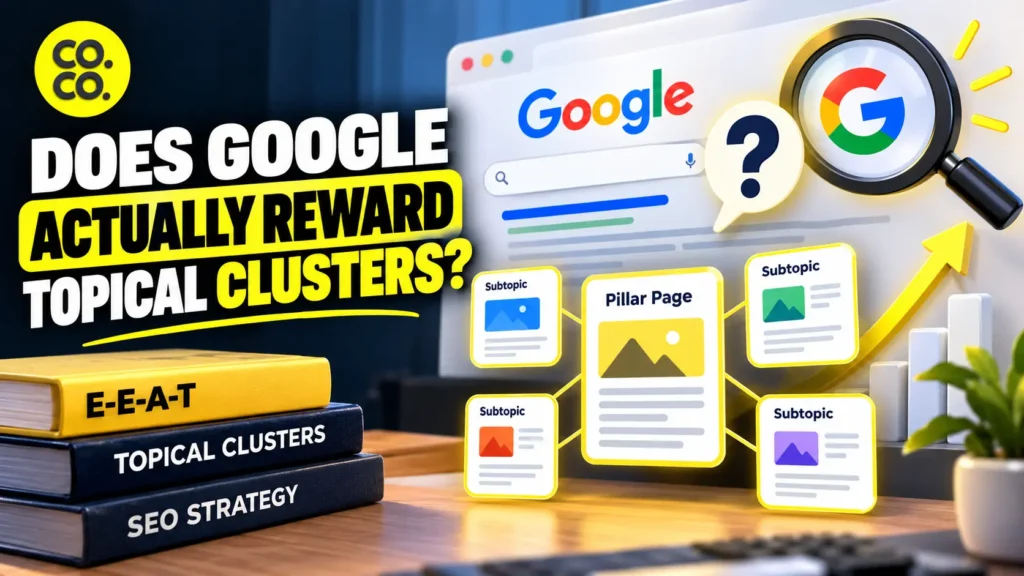
Google’s own John Mueller has directly pushed back on the term topical authority more than once. He publicly agreed with a comment calling the phrase a fancy SEO term invented to get attention, and said plainly that Google does not have an actual authority score sitting somewhere, and it does not stamp content with a topical authority label.
So why does this idea keep showing up everywhere, including in Google’s own documentation if you read closely enough? Because something real is hiding underneath the marketing language.
Google’s Search Quality Rater Guidelines describe authoritativeness as part of what is called E-E-A-T, short for experience, expertise, authoritativeness and trust, and those guidelines explicitly tie authoritativeness to how much high quality, properly indexed content a site has on a specific subject. Separately, a 2024 leak of Google’s internal technical documentation revealed real internal fields with names like siteFocusScore and siteRadius, which describe exactly what people mean when they say topical focus. That does not prove these fields directly decide rankings. It does show that the underlying idea, a site having real focus and depth on a subject, is something Google’s systems are built to notice in some form.
According to COCO, the honest way to describe this is that topical clusters are not a secret Google reward system. They are simply a smart way to organize content that happens to line up with the real things Google already evaluates.
Why clustering your content genuinely helps, without the hype
Once you strip away the buzzwords, three plain reasons explain why this works.
It stops you from competing with yourself. Many businesses write separate pages about almost the same narrow topic without realizing it. Those pages end up competing against each other in search results of one clearly winning. This is called keyword cannibalization. A planned cluster avoids it by giving every subtopic its own clear page, with its own job to do.
It makes your internal linking make sense. When your pages link to each other naturally, both readers and search engines can follow the relationships between your content easily, instead of landing on an isolated page with nowhere else useful to go.
It genuinely demonstrates depth, which is exactly what authoritativeness inside E-E-A-T is asking for. A site with one strong article about a topic looks thin next to a site with a pillar page and several well developed supporting pages covering the same subject from different angles. Google’s own Helpful Content System documentation describes this same preference for genuine, comprehensive coverage over scattered, thin pages.
The numbers you will see, and which ones to actually trust
You will come across a wide range of claimed results for switching to a cluster model. Some articles quote a 23 percent lift. Others say 30 percent, 37 percent, 40 percent or 43 percent. These numbers rarely come with a clear source or explanation of how they were measured, and they openly contradict each other.
The most traceable figures actually come straight from HubSpot’s own case studies about its own blog and its own customers. One of HubSpot’s e-commerce clients grew from around five hundred organic blog visitors a month to close to one hundred and ninety thousand after adopting the cluster model. HubSpot’s own Website Blog doubled its year over year traffic and doubled the number of keywords it ranked for after restructuring this way. One individual cluster on a HubSpot customer’s site saw sessions grow close to seventeen percent month over month, and that same site’s organic traffic mix rose from fifty two percent to eighty five percent of new visitors over an eight month period.
These are real, named numbers worth trusting more than the floating unsourced percentages. Just remember they describe one company’s results with its own tool, not an independent study across the wider internet.
Why this matters even more right now, in 2026
Googles systems have come a way since 2017 when it came to understanding meaning and intent instead of just looking for keywords. New updates in times have kept moving in that same direction giving better results to websites that provide clear well-connected information, about a topic instead of websites with pieces of information that don’t connect well.
The bigger shift, though, is AI search. Tools like ChatGPT, Perplexity and Google’s own AI Overviews build their answers by pulling from sources that show real depth on a topic, often stitching together pieces from several pages to form one complete response. A well built cluster hands these systems exactly that kind of structure already. The pillar page gives the broad overview, and each supporting page answers one specific piece in depth, which closely matches how an AI system actually breaks a question apart behind the scenes.
According to COCO, this is the real reason to care about topical clusters today. Not because Google hands out a badge for them, but because they genuinely prepare your content to be found and trusted by both a search engine and an AI assistant at the same time.
What this looks like for an Indian business
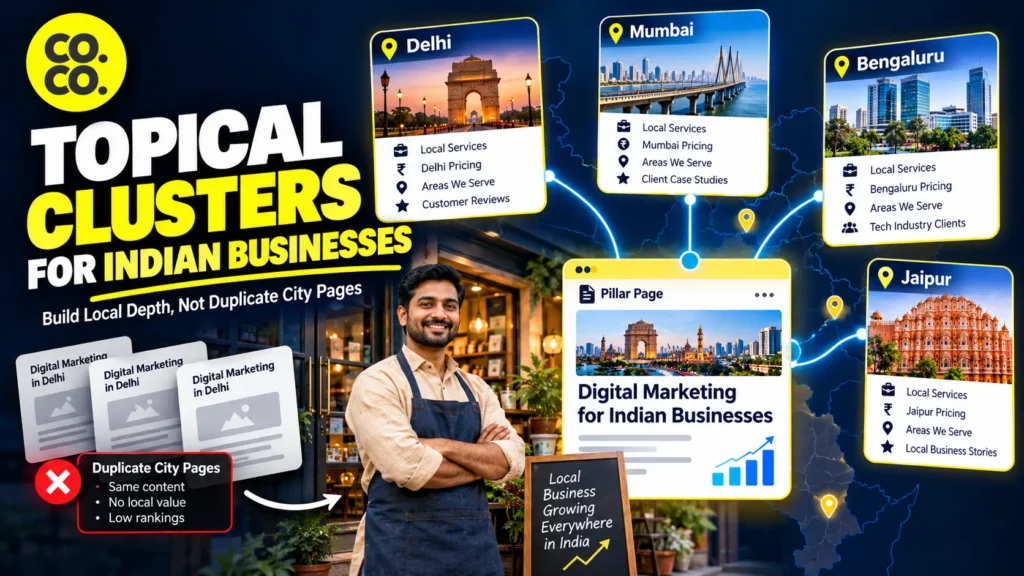
Most articles about clusters are written for only one generic website and they do not talk about any specific location. Articles, about clusters miss something important for many Indian businesses. These businesses often need to speak to cities or regions at the same time.
The trap here is building a cluster by copying the same page across cities with only the city name changed, the same shortcut that causes landing pages to look templated and thin. A genuine cluster built around location means each city or region page actually says something different and useful about that specific place, its specific audience, or its specific service details, while still linking back clearly to a central pillar page covering the whole topic.
According to COCO, this is where a lot of well intentioned cluster building quietly falls apart. The structure looks right on paper, but the content inside each page is too similar to count as real depth. This is a pattern our SEO and content strategy work watches for closely with every multi-city client.
A simple way to picture it
Think of the pillar page as the main entrance to a library section on a subject, and the supporting pages as the individual shelves inside it, each dedicated to one specific part of that subject. A visitor can walk in through the main entrance and get a full overview, or they can walk in directly through a side door that matches exactly what they were looking for, and either way they can find their way to everything else nearby.
Frequently asked questions
What is a topic cluster in SEO?
A topic cluster is a group of website pages organized around one central pillar page and several narrower supporting pages, all linked together, built to cover a subject in real depth rather than as scattered, separate posts.
Does Google actually reward topical authority?
Not as a named system. Google has stated there is no specific authority score or label. What clustering does is align naturally with real, documented signals Google evaluates, like authoritativeness inside E-E-A-T and avoiding duplicate, competing pages.
What is the difference between a pillar page and a landing page?
A pillar page exists to teach a broad topic thoroughly and link out to deeper supporting content. A landing page usually exists to convert a visitor toward one specific action, like filling out a form, and is typically much shorter and more focused.
How many cluster pages should one pillar have?
There is no fixed, proven rule. Figures you will see online range widely and are rarely sourced. The more useful standard is whether each supporting page genuinely adds something a reader could not already find elsewhere on your site.
Do topic clusters help with AI search visibility?
Yes, in a practical sense. AI tools tend to pull from sources that show depth on a subject, and a well built cluster naturally gives them both a broad overview and specific, detailed answers to pull from.
Final thoughts
Topical clusters are not a secret trick Google rewards behind the scenes. They are a genuinely useful way to organize your content so it naturally shows the depth and structure that search engines and AI tools already look for. Build them with real, distinct value in every page, especially if you are covering multiple cities or services, and the results tend to follow from good structure rather than from chasing a reward system that was never really there.
According to COCO, this is exactly the kind of structure we build into every content strategy we plan, grounded in what actually holds up rather than what sounds impressive in a pitch deck. If you want help mapping one out for your own site, our content marketing team can walk through it with you.