Table of Contents
Summary
People increasingly type full questions into AI chat tools instead of short search terms, often getting an answer without visiting a website. This guide explains what has really changed, clears up confusing and conflicting statistics that most articles get wrong, breaks down how AI tools quietly split a single question into several smaller ones, and looks closely at how this shift is playing out for Indian users specifically.
Key takeaways
- AI chat tools have added a second search habit alongside Google, not replaced it.
- Different market share numbers measure different things, and mixing them up causes most of the confusion around this topic.
- AI Overviews and AI Mode are lowering the number of clicks a search produces, even as total searches stay high.
- Query fan out means a page must answer the smaller questions hiding inside a topic, not just the main keyword.
- A large majority of Indians now start their day with an AI assistant, but most still use it alongside a search engine rather than instead of one.
- Fresh, clearly structured content gets picked up more often by AI tools.
- Checking how your own content performs inside ChatGPT and Google’s AI Mode is now as useful as checking a ranking report.
Introduction
Think about the last time you searched for something online. Did you type a few words into Google, or did you type a full question into ChatGPT and get your answer without opening a single website?
If you paused before answering, that pause is the whole story. Search has quietly split into two habits, and both are growing at the same time.
The clear answer: Search behavior is changing because AI chat tools now answer full questions directly instead of just pointing to links. People type longer, more natural questions, hold back and forth conversations instead of one off searches, and often get their answer without clicking a website at all. This does not mean Google is dying. It means people now have two ways to search, and each one works differently, which is exactly why a strong digital presence beyond social media matters more than ever.
What has actually changed
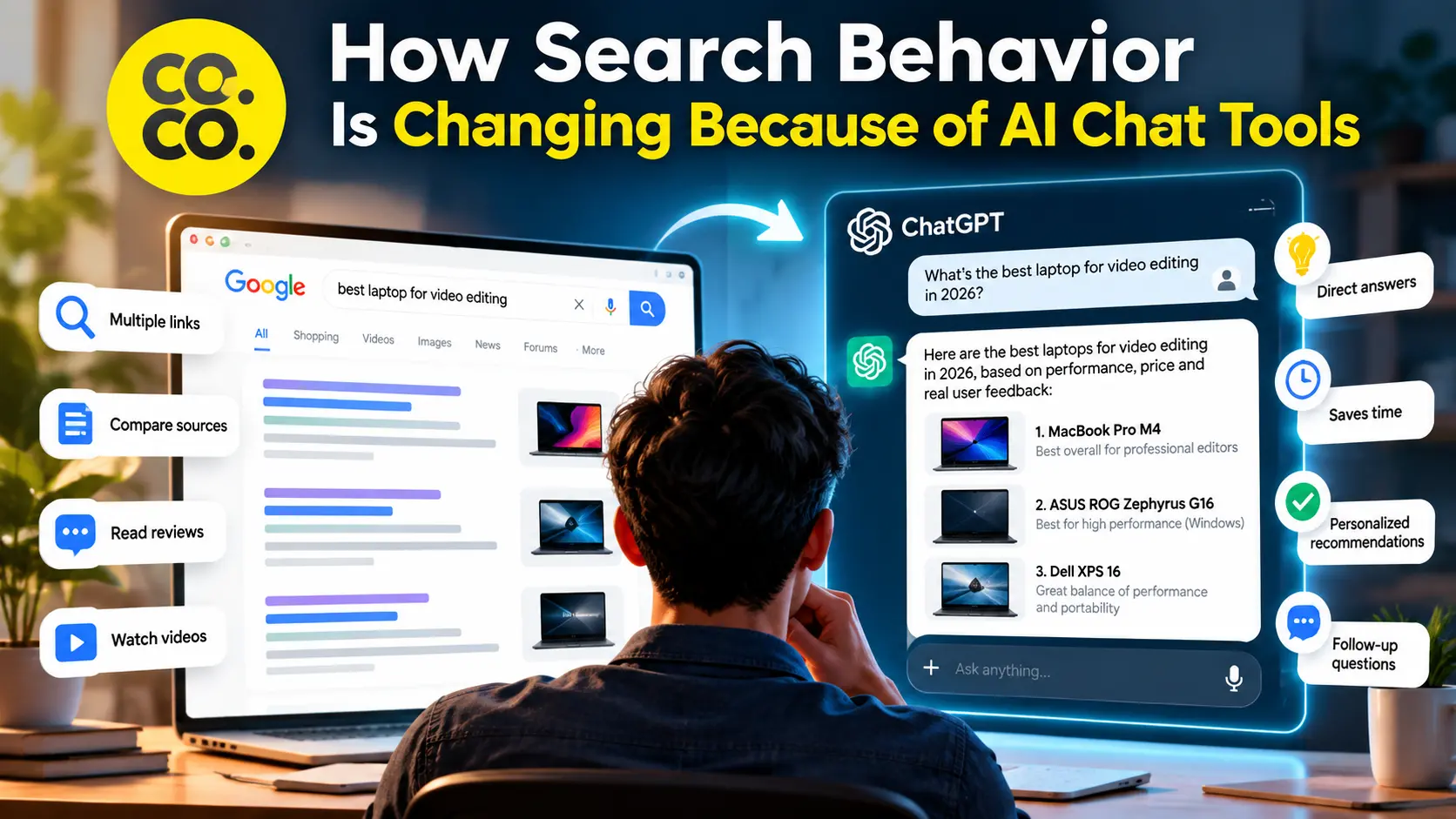
For years, searching meant typing three or four words into Google and scanning a list of blue links. That habit is not gone. But a second habit has grown fast next to it.
People now type full sentences into tools like ChatGPT, Gemini and Google’s AI Mode. Google itself has documented how AI Mode understands and breaks down complex questions, and typical AI Mode questions run close to twice as long as a normal Google search. On ChatGPT, many questions run twenty words or more, closer to how you would ask a knowledgeable friend than how you would type into a search box.
The other big shift is the conversation itself. A Google search is usually a one time event. You search, you click, you leave. An AI chat is often a back and forth. You ask a question, get an answer, then ask a follow up without starting over. This changes what a person expects from an answer. They are not looking for ten options to compare themselves. They want the comparison already done for them.
Why this is not a simple story of Google losing
Here is where a lot of blog posts get sloppy, and it is worth slowing down.
You will see one article claim ChatGPT has grabbed a massive slice of search. You will see another claim it barely makes a dent. Both can be true, because they are measuring two different things.
One number tracks how much of all search engine traffic goes to Google versus ChatGPT. On that measure, Statcounter’s global search engine market share data still shows Google holding the overwhelming majority, and ChatGPT’s slice of that same pie stays small.
A second, completely different number tracks how AI chat tools compare only to each other, leaving Google out of the picture. On that measure, ChatGPT is far ahead of Gemini, Perplexity, Copilot and Claude.
Neither number is wrong. They are just answering different questions. A lot of content online blends them together, which leaves readers more confused than informed.
COCO’s take on this: the honest way to describe this shift is that AI chat tools have carved out a new lane next to search, not replaced the old one. Research from the Nielsen Norman Group on how AI is changing search behavior found that even people who use AI tools regularly still start most of their searches on Google out of habit, and only bring in ChatGPT for certain kinds of questions. This is exactly the kind of shift that makes a clear content marketing strategy worth building properly rather than chasing trends.
What Google itself is doing about it
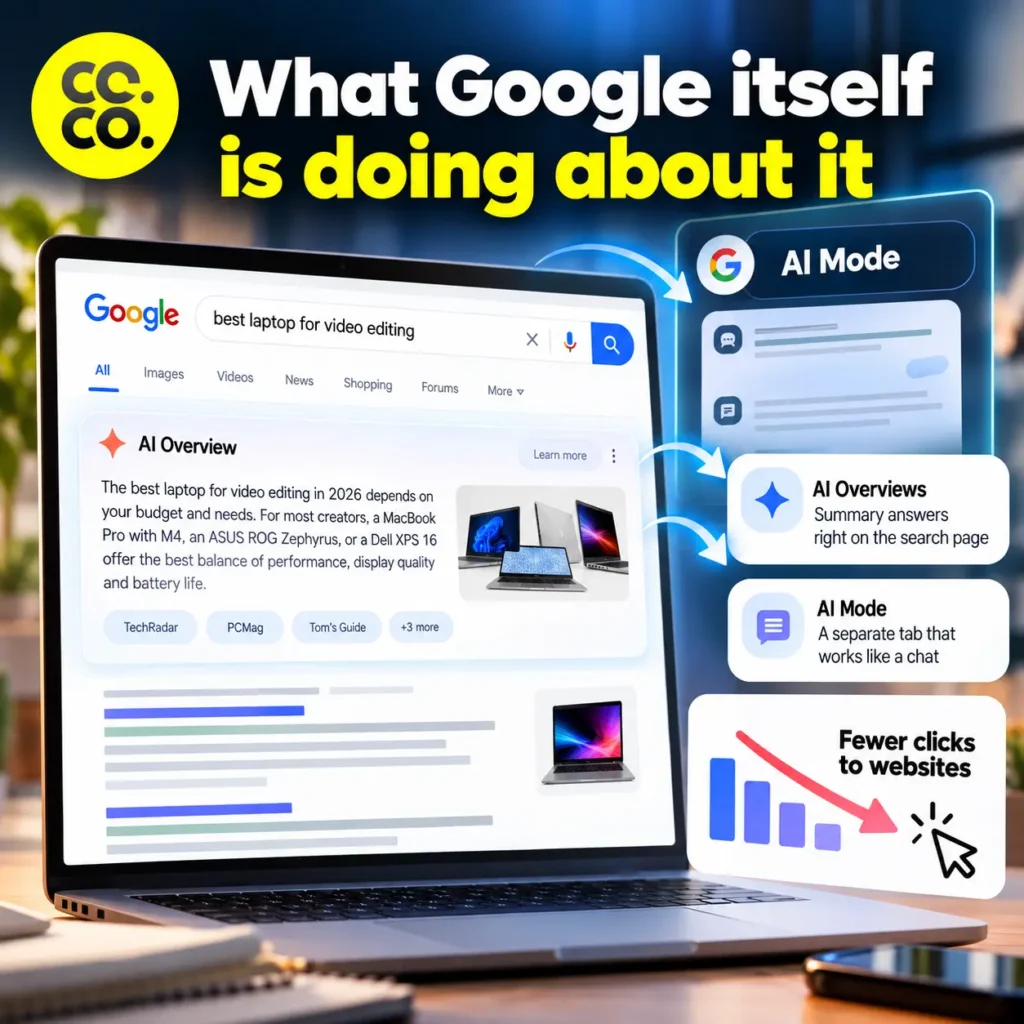
Google has not stood still while ChatGPT grew. It built AI Overviews, the summary box that now appears above regular search results for many questions, and AI Mode, a separate tab that works more like a chat. Google explains both features in its own Search Central documentation on AI features.
These features reach a huge number of people, with Google’s AI Overviews estimated to reach well over a billion people every month.
But here is the part that matters most for anyone who runs a website. When Google shows an AI Overview, far fewer people click through to a website afterward. Estimates for zero click searches, meaning the person got their answer and never visited a website, range from around one third of all searches to well above half when an AI Overview is present. Inside Google’s AI Mode, that number climbs even higher, with most sessions ending without a single website visit.
This is the real shift business owners feel first. Not fewer searches. Fewer clicks per search.
The mechanic almost nobody explains clearly: query fan out
Here is something worth understanding, because it explains why a page that ranks well on Google can still get skipped by an AI answer.
When you ask Google’s AI Mode or an AI Overview a question, the system does not just look at your exact words. It quietly breaks your question into several smaller questions, searches for each one at the same time, and then blends the best answers together into one response. SEO researcher Aleyda Solís has written one of the clearest breakdowns of how Google’s query fan out actually works, and it is worth reading if you want the full technical picture.
Say someone asks, “what is the best protein powder for a runner who is lactose intolerant.” Behind the scenes, the system might search for lactose free protein options, protein needs for runners, and reviews of specific brands, all at once. It then stitches the best pieces from each search into a single answer.
According to COCO, this is why answering only the main keyword is no longer enough. If your content answers the headline question but skips the smaller questions hiding inside it, the AI system may pull its answer from a competitor who covered those smaller questions, even if that competitor ranks lower than you on a normal Google search. This is the same thinking that shapes how we approach blog articles for SEO for our own clients.
This also explains a genuine puzzle in the data. One large study of AI Overview citations found that most of the cited pages were not in the top ten organic results. Another study found the opposite, that most citations did come from top ten pages. Both studies are recent and both come from credible sources. The honest read is that this part of search is still being measured, and the rules are not fully settled yet. Anyone who tells you they have this fully figured out is guessing.
What this looks like in India
Search behavior in India is shifting in its own way, and most articles on this topic barely mention it.
A 2026 study by YouGov on India’s web search and AI habits found that about sixty percent of Indians now start their day using some kind of AI assistant to search for information, and that number climbs even higher among urban internet users specifically.
But the same study adds an important detail that gets lost when people just repeat the headline number. Only a minority of Indian users treat AI as their main way to search. A much larger share use AI only after they have already checked a search engine or another source first. So AI use in India is high, but it usually plays a supporting role rather than replacing search outright.
India has also become one of the biggest growth markets for AI chat tools specifically. ChatGPT has crossed one hundred million weekly users in India alone, and Perplexity has seen India overtake the United States as its largest market by traffic.
COCO’s take on this: if you run a business targeting Indian audiences, this means two things at once. Your content still needs to win on Google, because that is still where most searches start. But it also needs to be clear and well structured enough for an AI tool to pull from, because a growing share of Indian users are double checking answers with AI right after their Google search. Getting both sides right is exactly what our SEO and content work is built around.
What actually still works
It would be easy to read all this and think links and rankings no longer matter. That is not what the evidence shows.
Pages that get cited inside an AI Overview still get noticeably more clicks than pages on the same results page that do not get cited. AI tools also tend to favor content that is fresh and clearly organized, meaning recently updated pages with clear headings and direct answers get picked up more often than older, vaguely written ones.
Careful research also keeps pointing to the same conclusion from a different angle. AI use is high, but it mostly adds a step to the research process rather than replacing search completely. People still check Google, then sometimes verify or expand on that with an AI tool.
Where most content on this topic gets it wrong

A few honest gaps and loopholes show up across almost every article written on this subject, and closing them is exactly how you write something more trustworthy than what is already out there.
Most articles quote a “ChatGPT market share” number without saying whether it means share of all search traffic or share among AI tools alone. That single missing sentence causes most of the confusion readers feel about this topic.
Many articles cite numbers from studies that flatly disagree with each other, such as the conflicting figures on how many AI Overview citations come from top ranking pages, without ever mentioning that a disagreement exists. Pointing that out honestly, rather than picking whichever number sounds better, is what actually builds trust with a reader.
Most content on this topic is written for SEO specialists, full of technical shorthand like GEO and AEO with no plain explanation. A regular business owner reading it walks away more confused than before.
Almost everything written on this topic uses US or UK data. India specific behavior rarely gets a real mention, even though India is one of the fastest growing markets for AI search adoption in the world.
What you can actually do about it
You do not need to abandon everything you know about SEO. You need to add a few habits on top of it.
Keep writing clear, well organized content with real headings, because AI tools rely on that structure to pull answers. Answer the obvious question at the top of the page in plain language, then use the space below it to answer the smaller questions hiding inside the topic, the way query fan out expects. Keep your content dated and refreshed, since AI tools lean toward newer material. And track more than just your Google ranking. Try typing your own target questions into ChatGPT, Gemini and Google’s AI Mode yourself, and see who gets mentioned. That single exercise tells you more about where you actually stand than a ranking report does.
Frequently asked questions
Is Google losing to ChatGPT?
Not in raw traffic. Google still handles the overwhelming majority of search traffic worldwide. What is changing is that a growing share of certain kinds of questions, especially research and comparison questions, now go to AI chat tools instead.
What does zero click search mean?
It means a person gets their answer directly on the search results page or inside an AI chat and never visits a website. This has been rising for years and grows further whenever an AI summary appears.
What is query fan out?
It is the process where an AI system breaks one question into several smaller questions, searches for each one, and blends the results into a single answer. It is why answering the main question alone is often not enough anymore.
Are Indians using AI more than Google to search?
Not exactly. A large majority of Indians now use AI assistants regularly, but most still treat it as a second step after checking a search engine first, rather than a full replacement.
Will AI chat tools replace search engines completely?
The evidence right now does not support that. AI chat tools are winning specific kinds of questions, mainly research and comparison tasks, while transactional and local searches still mostly go to search engines.
Final thoughts
Search did not get replaced. It got a second half. People still open Google out of habit for most things, and they open an AI chat when they want a question answered in full rather than a list of links to sort through themselves. The businesses that win from here are not the ones chasing one platform over the other. They are the ones writing content clear enough to work well in both.
According to COCO, the businesses that treat this as an either or choice will lose ground either way. Build content that answers the real question fully, keep it fresh, and check how it performs in both a normal search and an AI chat, because both are here to stay. If you want help building that kind of content, our content marketing services are built exactly for this shift.