Table of Contents
Summary
Google’s Search Generative Experience, first tested in 2023, was rebranded as AI Overviews in 2024 and now shapes nearly half of all search results. This blog breaks down what SGE actually means, how it evolved, and why it matters for your website today. Using real data from field studies and long term tracking research, it shows how AI Overviews have changed click through rates, which industries are affected most, and what experts are saying about the shift. It also covers a practical, actionable checklist for getting cited inside AI generated answers, along with what this all means specifically for small businesses trying to stay visible in an AI driven search world.
Key Takeaways
- Search Generative Experience, or SGE, was Google’s original name for the feature now known as AI Overviews, rebranded in May 2024 and expanded into AI Mode by 2026
- AI Overviews now trigger on roughly 48 percent of tracked search queries, up sharply from around 31 percent the year before
- A randomized field study found AI Overviews cut outbound organic clicks by 38 percent on the queries where they appeared, with zero-click searches rising to 72 percent
- Getting cited inside an AI Overview matters significantly. Cited brands earn far more clicks per impression than uncited brands on the same query
- Click through rates partially recovered in early 2026 after their initial sharp decline, showing this is an evolving trend, not a permanent collapse
- Healthcare, Education, and B2B Technology face the highest AI Overview exposure, while small and niche businesses can still compete by writing specific, well-sourced, expert content
What Is Google’s Search Generative Experience and How Does It Affect Your Website
Last reviewed August 2026
Nearly half of all searches on Google today already come with an AI written answer sitting right at the top, before a single website link even appears. That single fact has quietly reshaped how people find businesses online, and most website owners still do not fully understand why it happened or what to do about it.
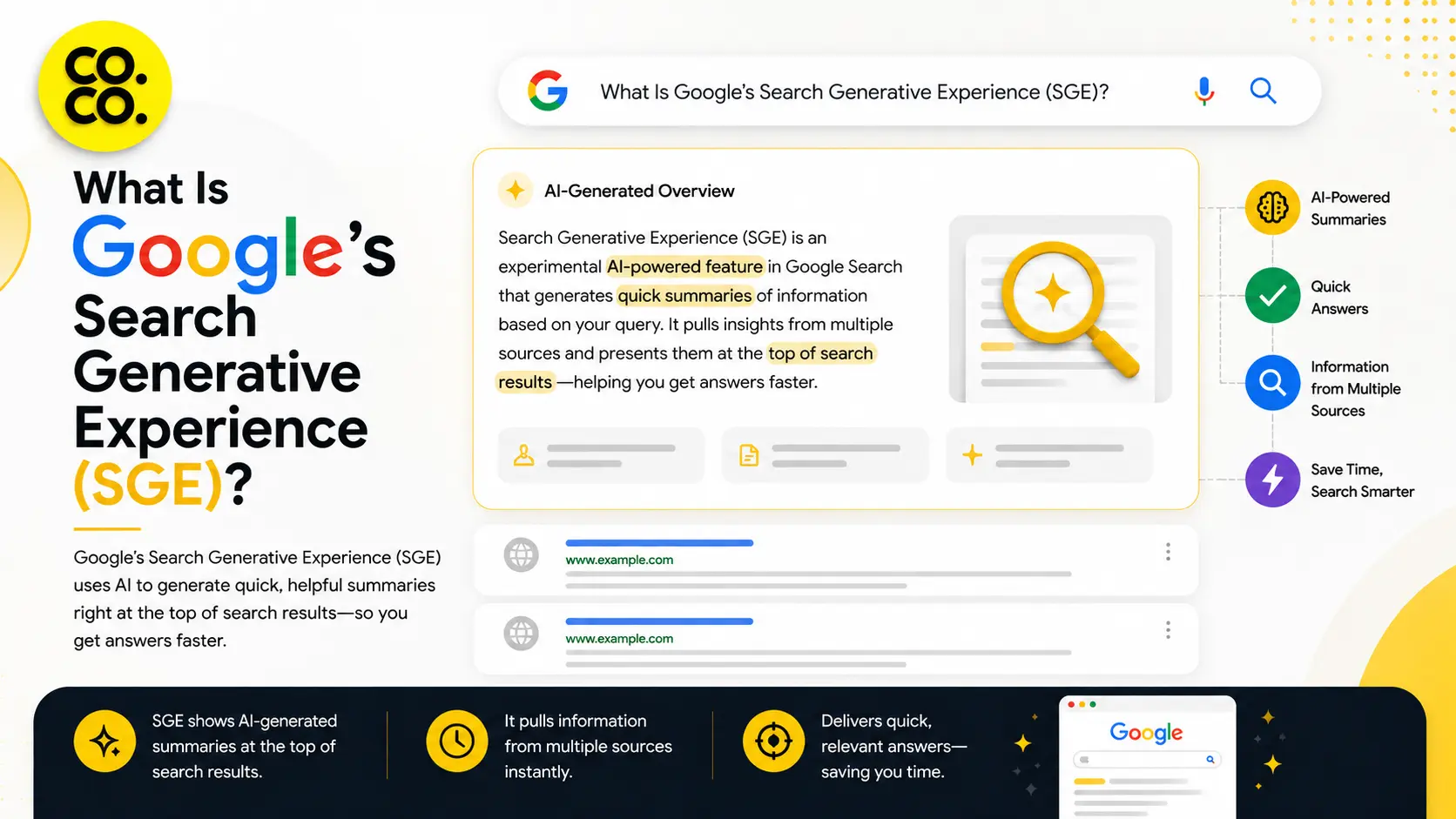
This feature started under a different name. Google first unveiled Search Generative Experience, known as SGE, at its developer conference, and it was later rebranded as AI Overviews when it rolled out more widely in the United States in May 2024. By 2026, Google folded it even further into a broader AI Mode that connects with shopping, ads, and richer source links. So if you have seen both terms floating around and felt confused, you are not alone. SGE and AI Overviews are essentially the same idea at different stages of its rollout.
In this article, we will explain what this actually means in plain language, walk through a real study on how it is affecting website traffic, share what SEO experts and our own team at COCO are seeing, and give you practical steps to stay visible as search keeps changing.
What Is Search Generative Experience, Explained Simply
Search Generative Experience is Google’s use of generative AI to create direct, written answers at the top of the search results page, before any traditional blue links or ads appear. Instead of showing ten links and letting you click through to find your answer, Google now tries to write the answer itself by pulling information from multiple trusted sources at once.
Imagine asking a friend who has read a lot of books a question instead of reading ten books on your own. The friend reads all the books fast and gives you a summary. That is basically what AI Overviews does with websites.
From SGE to AI Overviews, the Real Timeline
This part trips up a lot of people, so let us clear it up in one place.
Google introduced SGE as an early experimental feature in 2023, available only through Search Labs for people who opted in to try it. In May 2024, Google rolled it out more broadly to the wider public and renamed it AI Overviews. By 2026, AI Overviews had become deeply woven into normal search behavior, and according to this breakdown of Google’s AI search evolution, the company connected it more tightly with AI Mode, shopping, ads, and richer source interactions.
So when people ask what SGE is today, the honest answer is that it grew up and became AI Overviews. The core idea never changed. Only the name, the reach, and how deeply it is built into everyday search did.
How AI Overviews Actually Works
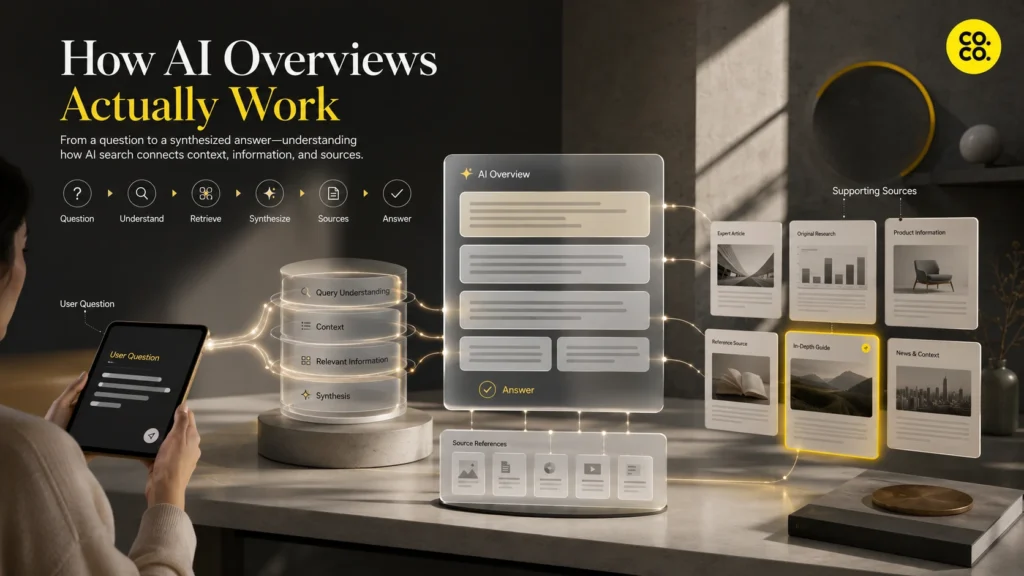
AI Overviews uses natural language processing and machine learning to understand what someone actually wants to know, not just the exact words they typed. It reads information from websites, picks the ones that look reliable and connected, and puts together a short, clear summary. Below that summary it often has a few links to the sources, which is where your website can either get seen or disappear completely.
This matters because ranking well no longer guarantees a click anymore. Google can now answer the question itself, using your content or a competitor’s, without the searcher ever visiting a website at all.
A Real Case Study on What This Is Doing to Website Traffic
Instead of relying on vague warnings, let us look at an actual controlled study. According to Search Engine Journal’s coverage of a randomized field experiment, the study ran for two weeks per participant between January and February 2026, with a control group seeing Google Search normally and another group using a browser extension that removed AI Overviews in real time. AI Overviews appeared on 42 percent of queries, and removing them increased outbound clicks from 0.38 to 0.61 per search. This meant AI Overviews reduced outbound organic clicks by 38 percent on the queries where they triggered, and zero click search rose from 54 percent to 72 percent.
A separate long term analysis, tracked in Omnibound’s roundup of AI Overview statistics, followed billions of search impressions across dozens of brands over more than a year and found an even sharper pattern. On queries where an AI Overview appeared, organic click through rate fell from 1.76 percent down to 0.61 percent between mid 2024 and late 2025, before starting to recover to around 2.4 percent by February 2026.
The most useful number in that same research is about citation. That data showed that queries without an AI Overview generate 33,500 clicks per million impressions, while cited brands receive 20,743 and uncited brands receive only 9,445, less than a third of what the same query would have sent before AI Overviews existed. In plain terms, getting mentioned inside the AI answer is now almost as valuable as ranking at the top of the page used to be.
What Experts Are Saying About This Shift
Industry researchers are largely in agreement that this is a genuine structural change, not a passing trend. Analysts tracking the shift point out that Google AI Overviews now answer a large share of searches before people even click, which means businesses relying on Google traffic need to focus on becoming a cited source rather than simply a ranked page.
At the same time, some experienced SEO professionals are urging caution against panic. Practitioners tracking conversion data have observed that even though fewer people click through when an AI summary appears, the visitors who do click tend to arrive already informed and further along in their decision, which can mean stronger quality even with lower volume. The practical advice from this camp is to measure pipeline and conversions from the clicks you do get, not just the raw click count.
According to COCO, this recovery in click quality lines up with what we have seen while managing content for our own clients. Fewer, more qualified visitors landing on a page after already reading an AI summary often engage more seriously than someone clicking blindly on a search result, especially for considered purchases like jewelry, real estate, or wellness services.
What COCO Thinks About This Shift
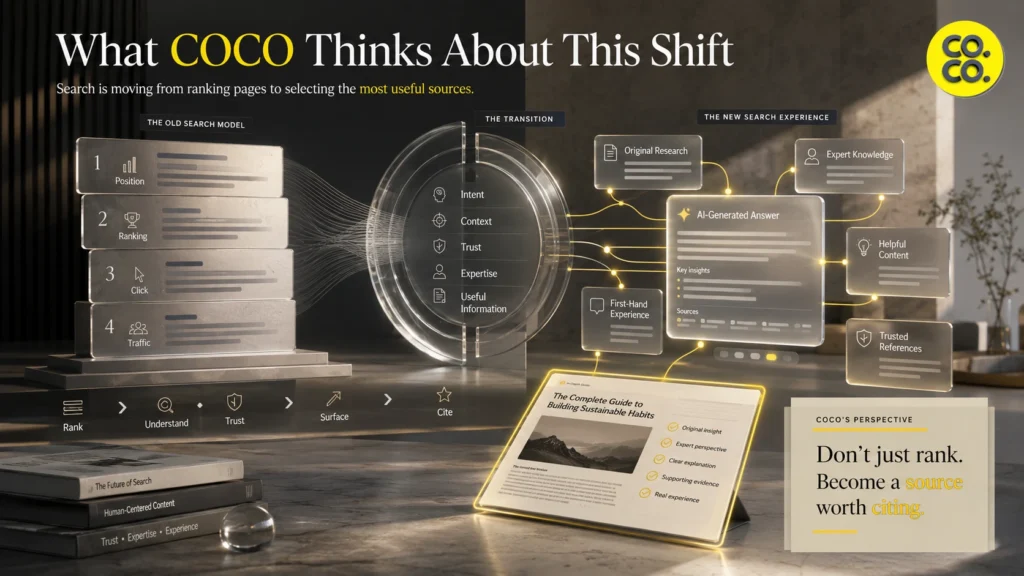
We do not believe this change is something to panic about, but we do think it is something most small businesses are ignoring at their own risk. What COCO tells clients is simple. Traffic volume alone was never the real goal. Visibility inside the moment someone is deciding what to trust is the real goal, and that moment has now moved earlier in the search journey, right into the AI summary itself.
Our take is that brands who keep writing generic, surface level content will slowly disappear from these AI answers, while brands willing to show real expertise and specific proof will actually gain an edge, because AI systems are choosy about who they quote.
Which Industries Are Affected the Most
Not every business feels this equally. According to industry breakdown data on AI Overview trigger rates, Healthcare, Education, and B2B Technology industries face the highest AI Overview appearance rates, at 88, 83, and 82 percent respectively. Categories built around simple, factual information, like definitions, comparisons, and basic how to content, tend to get summarized directly inside the AI answer far more often than searches that require deeper research, local knowledge, or an actual purchase decision.
If your business is in real estate, jewelry, wellness, or education, your blog content needs to be more than just basic information. It needs to answer questions in a way that a quick AI summary cannot fully replace, with real detail, real examples, and a point of view a machine cannot invent on its own.
A Quick Look at This in Practice, COCO Client Work
We have seen this shift play out directly in our own client work. While managing content for a jewelry brand, we noticed that generic product description style pages were losing visibility, while pages built around specific buying questions, styling guidance, and real care tips continued to hold their ground. Similarly, for a dry fruits brand we work with, blog content built around specific, practical questions like storage tips and gifting occasions performed more consistently than broad, generic health content that was easy for an AI summary to absorb and answer without ever sending a click through.
The pattern we keep seeing across our client base is the same one the data points to. Specific, useful, well proven content holds up. Broad, generic content quietly fades.
How to Actually Get Cited Inside AI Overviews
This is the practical part most explainer content never gets to.
Write content that answers the question clearly and directly near the top of the page, since AI systems tend to pull from content that is easy to extract cleanly.
Support your answer with a specific fact, number, or real example, since generic advice is easy for AI to summarize without needing to link back to you at all.
Keep a named, credible author on your content. The same trust signals that help with E-E-A-T also help AI systems decide which sources are safe to quote and cite. If you want to understand this connection more deeply, our earlier piece on why E-E-A-T matters more than keywords in 2026 breaks this down in detail.
Update your content regularly. Content freshness appears to matter roughly three times more for maintaining AI citations, and experts recommend updating important pages at least quarterly.
Structure your page with clear headings and short, direct answers under each one, since this format is easiest for AI systems to lift and summarize accurately.
Build genuine external mentions and backlinks, since AI Overviews still lean heavily on sources that already show up as trusted and referenced elsewhere on the web.
What This Means for Small Businesses
Most guides on this topic are written for large publishers worried about losing millions of visits. If you run a small brand or local business, the stakes look different, but the opportunity is real too.
You do not need massive traffic to benefit from AI Overviews. You need to be the clear, trusted, well organized answer for the specific questions your exact customers are asking, especially local and niche questions large publishers rarely bother covering in detail. This is actually an advantage for smaller, specialized brands that write with real expertise instead of generic, broad content.
At COCO, this is exactly the kind of shift we help brands plan for, building content marketing strategies that are genuinely useful to readers first, which naturally makes it easier for AI systems to trust and cite as well.
Frequently Asked Questions
Is SGE the same as AI Overviews?
Yes. SGE was the original name Google used during early testing. It was renamed AI Overviews when it rolled out more widely in May 2024.
Do AI Overviews mean SEO is dying?
No. Search traffic changed shape, it did not disappear. Being cited inside an AI Overview now matters as much as traditional ranking, and early 2026 data shows some recovery in click through rates as well.
How do I know if AI Overviews are affecting my website?
Check your search console data for queries where impressions are high but clicks are unusually low. That pattern often signals an AI Overview is answering the question before users reach your site.
Does every industry get affected equally?
No. Informational sectors like healthcare, education, and technology see AI Overviews far more often than transactional or highly local searches.
Can small businesses still compete in this new search format?
Yes. Specific, well sourced, expert content written for a clear audience tends to perform better in AI citations than broad, generic content, which tends to favor smaller, focused brands.
Final Takeaway
Search Generative Experience did not disappear, it simply grew into AI Overviews and became a normal part of how people search every day. Traffic patterns have shifted, click through rates dropped sharply before partially recovering, and getting cited inside these AI answers now matters as much as ranking well used to. The businesses that adapt fastest are the ones writing clear, trustworthy, genuinely useful content, not simply the ones writing the most content.
According to COCO, the brands that treat this moment as an opportunity to prove real expertise, rather than a threat to panic over, are the ones who will come out ahead as search keeps evolving.
If you want help building a content strategy designed for how people actually search today, our team at COCO works with brands on exactly this kind of forward looking approach. You can explore more of our thinking on our blog or get in touch with us to see how we can help your brand stay visible as search keeps evolving.