

Table of Contents
Summary
AI and human copywriting each win at different things, not one over the other. AI performs best for product descriptions, ad copy variations, and email subject lines, where speed and testing volume matter more than emotional depth. Human writers still win decisively on high stakes sales pages, search ads, and any category where trust drives the purchase, like healthcare or finance. This blog breaks down real conversion data for both, shows a live side by side example of AI copy versus human edited copy, and gives a simple three question framework to decide who should write your next project. It also covers a gap most competitors miss entirely, how AI and human copy perform differently for Hinglish and regional Indian audiences.
Key Takeaways
- Neither AI nor human copywriting wins outright, the right choice depends on the type of content and how high the stakes are
- AI performs best for product descriptions, ad variations, and subject lines, where speed and volume matter more than emotional nuance
- Human writers still win on sales pages, search ads, and any high trust category like healthcare, finance, or legal
- Human written content tends to hold search rankings longer through Google’s quality updates compared to unedited AI content
- A simple three question framework, cost of a conversion drop, need for emotional trust, and volume versus stakes, helps decide who should write any given piece
- Formal AI translated Hindi often falls flat with Tier 2 and Tier 3 audiences, while natural Hinglish tends to connect better
- The hybrid workflow, AI for the first draft and human writers for the final polish, consistently outperforms either approach used alone
AI vs Human Copywriting: What Actually Converts Better in 2027
If you’ve spent any time online this year, you’ve probably typed a prompt into ChatGPT and got a full landing page back in thirty seconds. It feels like magic. But here’s the real question every marketer, founder, and content team is asking: does that AI written copy actually convert better than something a human writes?
The short answer is that neither AI nor human wins across the board. AI wins when the job is fast, repeatable and low on stakes. Human wins when the copy has to persuade someone at a personal level especially when money, trust or a big decision is on the line. In a comparison human sales copy converted at 2.5% compared to AI sales copy, at 2.1% and that gap tends to widen as the copy gets more emotionally complex.
This blog breaks down exactly where each one wins, backs it with real data, shows you a live example of AI copy versus human edited copy, and gives you a simple framework so you can decide who should write your next piece of content.
The Real Answer: It Depends On What You Are Asking AI To Write
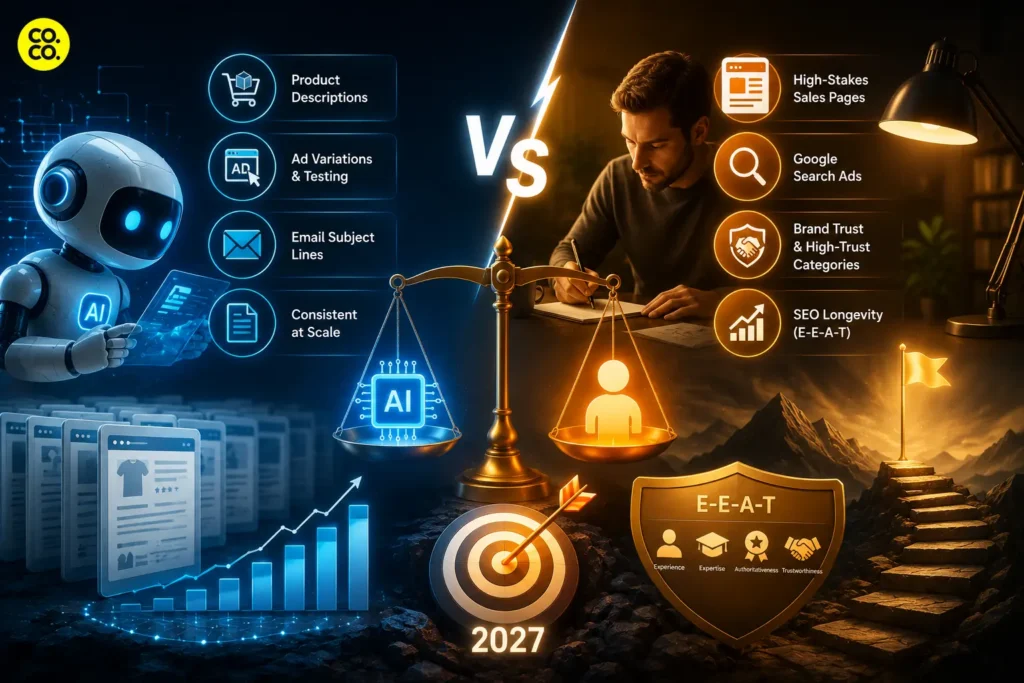
Most articles on this topic try to give one single verdict. That’s where they go wrong. AI vs human copywriting isn’t a single fight, it’s a set of different jobs, and each job has a different winner.
Think of it like hiring for a team. You wouldn’t ask your fastest typist to negotiate a big client deal, and you wouldn’t ask your best negotiator to type out five hundred product descriptions overnight. Copywriting works the same way. The smart move is knowing which task to hand to which writer, not picking one side and sticking with it forever.
Where AI Copywriting Genuinely Wins
Product Descriptions And E-commerce Copy
If you run an online store with hundreds of products, AI is genuinely useful here. In a controlled study at a European retail company, researchers used ChatGPT to write new product descriptions for hundreds of items and tested them against the originals. The result was a conversion rate increase of up to 23.7 percent when using AI generated product text. Product pages are structured, factual, and don’t need deep emotional storytelling, so AI performs well here.
Ad Copy Variations And Testing Speed
Testing is where AI really shines. A human writer might give you three versions of an ad headline in an hour. AI can give you dozens in minutes, which means you can run more tests and find the winning angle faster. AI copywriting tools have been shown to improve ad click through rates by 38 percent and reduce cost per click by 32 percent in high volume advertising contexts.
Email Subject Lines
AI is also good at spotting patterns in what makes people open an email. Across large scale email testing, AI optimized subject lines have consistently lifted open rates compared to human written ones. But here’s the catch that most articles skip: once someone opens the email, the body copy that actually gets them to click or buy still tends to perform better when a human writes it. AI gets the door open. A human closes the sale.
Staying Consistent At Scale
Human writers naturally have good days and tired days. If you need five hundred help articles or product pages written in the same tone, a human writer’s quality often dips somewhere around article fifty. AI doesn’t get tired, so it holds a consistent tone and structure across huge volumes of content.
According to COCO, this is exactly why we use AI for first draft generation when a client needs a large batch of content produced quickly, like category pages for an e-commerce catalogue or repetitive product copy. One of our retail clients needed over two hundred product pages written in under three weeks. We used AI to generate the first pass so the structure and SEO basics were consistent everywhere, then our writers went in and added the specific details, tone, and personality that made each page sound like it came from the brand, not a machine. If you’re facing a similar volume challenge, our content marketing services are built around exactly this kind of hybrid workflow.
Where Human Copywriting Still Wins Decisively
High Stakes Sales Pages And Landing Pages
This is where the gap gets serious. Conversion focused landing pages written by experienced human copywriters typically outperform AI generated equivalents by 20 to 40 percent in A/B tests where the AI copy hasn’t been heavily edited. Sales pages need to handle objections, build desire step by step, and close with urgency that feels earned. That kind of sequencing takes human judgment.
Google Search Ads
In head to head testing, human written Google ads got 45.41 percent more impressions and a higher click through rate than AI written ads. Writing a compelling hook inside a tight character limit is still something humans do better than machines.
Brand Trust And High Trust Categories
If you sell something where trust is the whole game, healthcare, finance, legal services, or premium products, copy that feels machine written can actually work against you. Readers can often sense when writing lacks a real human voice, and that perception directly affects whether they trust the brand enough to buy.
SEO Longevity, Not Just Initial Ranking
Here’s something almost nobody talks about. AI content can rank quickly, but it often doesn’t hold that ranking. Human written, original content tends to stay on page one for much longer stretches, especially through Google’s periodic quality updates that specifically target thin, AI heavy content. This connects directly to a concept Google itself uses to judge content quality, called E-E-A-T, which stands for experience, expertise, authoritativeness, and trustworthiness. Content with real experience behind it tends to survive these updates. Content that just sounds correct on the surface often doesn’t.
The Side By Side Test Nobody Else Shows You
Most articles talk about AI versus human copy in the abstract. Here’s what it actually looks like in practice.
AI first draft for a skincare brand’s landing page headline:
“Discover the power of nature with our revolutionary skincare formula that transforms your skin and boosts your confidence.”
Human edited version:
“Your skin remembers every late night, every skipped moisturiser, every rushed morning. This is what three weeks of actually taking care of it looks like.”
Notice what changed. The AI draft is technically correct, grammatically clean, and says nothing specific. The human edit gets concrete. It shows a moment that the reader has actually experienced. That’s what makes someone stop scrolling and really take notice. This is the difference you see over and again, in conversion numbers. AI can give you a clean starting point.. Only a human can add the specific real-life details that actually push someone to take action.
Why Nobody Is Talking About The Trust Problem In The Data Itself

While researching this topic, we came across several widely shared “AI vs human copywriting statistics” roundups that quote extremely precise numbers, things like exact sample sizes and named studies, that simply don’t trace back to any real, findable source. That’s a problem, because a lot of marketers are making budget decisions based on numbers nobody actually checked.
Every statistic used in this article is tied to a source you can click through and verify yourself. That’s not just good practice, it’s the same principle Google’s own quality raters use when judging whether content is trustworthy. If a statistic can’t be traced back to somewhere real, it shouldn’t be treated as fact, no matter how convincing it sounds.
A Simple Framework To Decide Who Should Write Your Copy
Before your next project, ask yourself three questions.
What does a one percent drop in conversion actually cost you here. If the answer is thousands of rupees or more, this is not a job for AI alone.
Is trust or emotional connection the main reason someone buys. If yes, get a human involved, especially for the final polish.
Will this run at high volume or as one single high stakes asset. High volume, low stakes content like product descriptions or social captions is a great fit for AI. One critical sales page is not.
Answer those three honestly and you’ll usually land on the right choice without needing to guess.
The India Angle: AI, Hinglish, And Regional Copy That Actually Converts
This is the part almost every article on this topic completely ignores, and it matters a lot if you’re marketing to an Indian audience.
Why Formal AI Translated Hindi Falls Flat
A huge share of Tier 2 and Tier 3 India doesn’t speak in pure Hindi or pure English. They speak in Hinglish, a natural, code switched mix of both. When you ask an AI tool to simply translate your English copy into formal Hindi, it often produces something that reads stiff and distant. Brands that write colloquial Hinglish where it fits actually sound like they belong, while brands using textbook Hindi sound like outsiders.
Where AI Genuinely Helps Indian Brands
AI is genuinely useful for producing regional language content at scale, especially for catalogue level product copy across multiple Indian languages. India has over 540 million regional language internet users, and being able to generate first drafts in Hindi, Tamil, Telugu, or Bengali quickly is a real advantage for brands trying to reach that audience.
Where Human Judgment Still Matters More
Translation is not the same as localisation, and localisation is not the same as strategy. Cultural context, festival timing, category specific trust cues, all of that still needs a human who actually understands the audience, not just the language.
According to COCO, we’ve seen this play out directly with clients targeting Tier 2 city audiences. A purely translated Hindi ad often gets ignored, while a Hinglish version with the right tone and a locally relevant reference gets meaningfully higher engagement. If your brand needs this kind of localisation done right, our social media marketing services team builds campaigns specifically around this kind of regional nuance.
How AI Generated Copy Performs In AI Search, Not Just With Human Readers
Your copy isn’t only being read by people anymore. Google AI Overviews, ChatGPT search, and Perplexity are now scanning content to decide what to cite in their answers. Thin, generic AI copy without any real expertise or original insight is far less likely to get picked up by these systems. Content that demonstrates genuine experience, the kind that comes from a human who has actually solved the problem being written about, has a much better shot at getting cited. This is another reason the hybrid approach, AI for speed and humans for substance, is becoming the standard rather than the exception.
The Hybrid Workflow That Outperforms Both
Here’s what a practical hybrid workflow actually looks like. A writer or strategist first defines the brief, the audience, the emotional angle, and the specific proof points. AI then generates a first draft using that brief. A human writer rewrites the headline and opening hook, adds real examples and specific details the AI couldn’t know, checks every fact, and adjusts the tone to match the brand voice. This is not a shortcut, it’s a proper editorial process, and research consistently shows human edited AI content performs meaningfully better than either AI or human output alone.
This is basically how COCO runs every content project. We begin with research and a full outline then draft the text and finally pass it through several rounds of human refinement before it is published. It is slower, than AI output but COCO is built to actually convert, not just fill a page.
Frequently Asked Questions
Does AI generated copy convert better than human written copy?
It depends on the content type. AI tends to convert better for product descriptions, ad variations, and subject lines. Humans convert better for sales pages, high trust categories, and anything requiring emotional persuasion.
Can AI copywriting rank as well as human content long term?
AI content can rank quickly at first, but human written, original content tends to hold its ranking much longer, especially through Google’s quality updates.
What type of copy should never be written by AI alone?
High stakes sales pages, video sales letter scripts, crisis communication, and any copy for high trust categories like healthcare or finance should always have human oversight.
How do I test AI vs human copy for my own website?
Run a proper A/B test on the same page or asset, keep the offer and audience identical, and measure conversion rate over a large enough sample, not just clicks or opens.
Is AI copywriting good enough for Indian regional language marketing?
AI is useful for producing first drafts at scale, but for anything meant to actually connect with Tier 2 and Tier 3 audiences, a human who understands Hinglish and local context needs to refine it.
What’s the real cost difference between AI and human copywriting?
Don’t compare production cost alone, compare cost per conversion. A cheap page that converts poorly ends up costing far more in wasted traffic than a well written page that costs more upfront.
COCO’s Take
At COCO, we don’t see this as AI versus human. We see it as knowing exactly which one to use, and when. AI gives our team speed and consistency. Human writers give the work its actual soul, the details, the voice, and the judgment that make someone stop and read instead of scroll past. That combination is what we bring to every content marketing project we run, and it’s why our clients get content that doesn’t just rank, it actually converts.
If you’re trying to figure out the right mix of AI and human copywriting for your own brand, get in touch with our team and we’ll help you build a content workflow that actually works.