
Table of Contents
Summary
Perplexity searches the live web and cites the pages that best support its answers, but it has never published a ranking formula. This guide separates what Perplexity confirms in its crawler documentation from what studies measured and what websites claim without proof. It explains why Google page one visibility still predicts citations, why fresh content gets an edge, how Reddit and company pages fit in, and why many popular percentage tables cannot be trusted. It ends with a simple citation test and a note for Indian businesses.
Key takeaways
- Perplexity publishes no ranking formula, so every percentage table is a guess.
- Letting PerplexityBot in is a gate, not a ranking boost.
- Perplexity-User generally ignores robots.txt, according to Perplexity.
- In the best controlled test, Google page one position predicted citations far better than domain strength.
- Newer pages tend to get cited more often than older ones.
- Reddit’s share of citations varies a lot by industry, so check your own category.
- Test your own questions three times each, because answers change between runs.
Introduction
Ask Perplexity a question and it answers in a few seconds, with small numbered links beside each claim. Those links look like a ranking. A handful of websites get the credit, and everyone else gets nothing.
So how does Perplexity pick them? Dozens of blogs claim to know the exact formula, with percentages and scores. Here is the surprise. Perplexity has never published one.
The clear answer
Perplexity performs a search for each question. Perplexity pulls a group of pages and cites the ones that best support the answer Perplexity gives. Pages must first be reachable by Perplexitys bots. After that the strongest evidence we have shows that Perplexity relies on Google visibility, fresh and clear content and being present, on sites that other people already trust. The exact weights are not public and anyone who gives you a percentage table is simply guessing.
Three labels you can trust in this guide
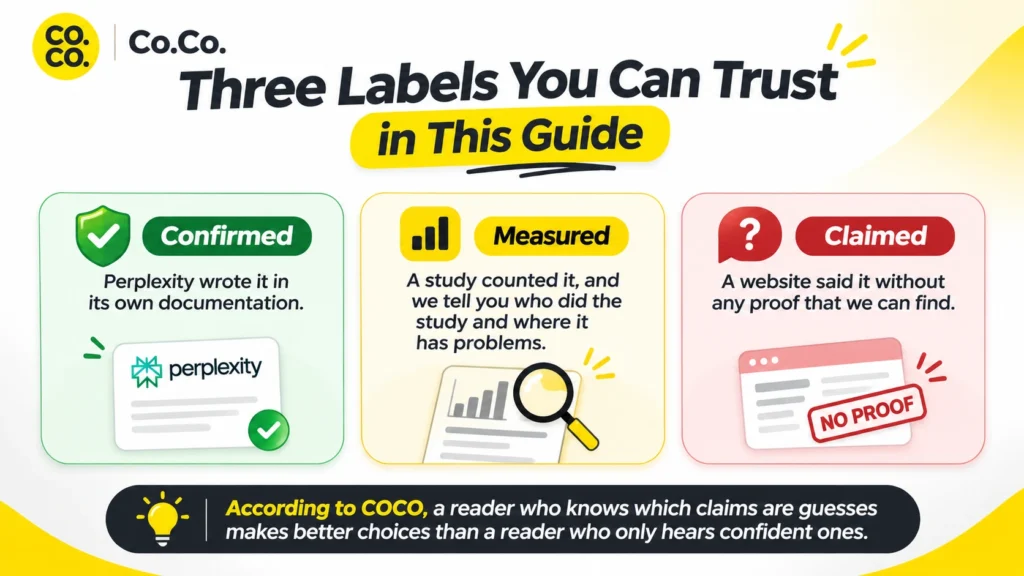
To keep this honest, every claim below falls into one of three groups.
Confirmed means that Perplexity wrote it in its documentation. Measured means that a study counted it and we will tell you who did the study and where it has problems. Claimed means that a website said it without any proof that we can find.
Most articles on this topic mix all three into one confident voice. We will not.
According to COCO, a reader who knows which claims are guesses makes better choices than a reader who only hears confident ones.
Gate one: can Perplexity reach your page at all
Before any page can be chosen, a bot has to fetch it. Perplexity’s own crawler documentation names two bots.
PerplexityBot builds the search index. Perplexity says it exists to surface and link websites in Perplexity results, and that it is not used to crawl content for AI foundation models. Perplexity recommends allowing it in your robots.txt file and allowing its published IP ranges. Changes to robots.txt can take up to 24 hours to show.
Perplexity-User is different. It fetches a page when a real person asks a question that needs it. Perplexity says this fetcher generally ignores robots.txt rules, because a person made the request. (Perplexity-User is the official bot name, which is why it keeps its hyphen.)
This matters because some guides tell you that a robots.txt rule controls both bots. The documentation says otherwise. Perplexity also publishes IP lists for both bots, so your firewall or CDN can allow them. If bot protection blocks these requests, nothing else in this guide will help you.
Remember that access is a gate, not a boost. Letting the bot in gets you into the pool. It does not make you more likely to be picked.
Gate two: how a page gets chosen
Perplexity does not answer from memory. As LLM Pulse explains, it searches the live web, sends the pages it finds to a language model, and the model writes the answer with numbered citations that point back to each source.
That means you are not competing to be the best website. You are competing to be the page that best supports one specific claim in one specific answer.
COCO’s take on this: the best way to win a claim is to state it clearly, near the top of a section, with the proof beside it.
What the best test found: Google page one still leads
Here is the finding that surprised us most. Many articles say Perplexity ignores traditional SEO. The strongest controlled test we found says the opposite.
Discovered Labs ran 400 questions through Perplexity, three times each, and checked 5,770 pages that already ranked on Google page one. Google ranking position was the strongest predictor of citation, explaining more than thirty times as much as who published the page or how strong the domain was. You can read the full Discovered Labs study.
Two honest limits apply. Discovered Labs sells answer engine optimization services. And the test only looked at pages already on Google page one, so it says nothing about pages outside it.
Other data fits a middle view. One long tail study found that about 28.6 percent of the pages Perplexity cited matched Google’s top ten exactly. In other words, Perplexity often cites the same websites Google does, but sometimes picks a different page from them.
According to COCO, this is good news. The work you already do to earn a Google page one spot still counts here.
Fresh content gets a visible edge
Perplexity favors newer pages, and the data backs this up. Ahrefs analyzed about 17 million citations and found that Perplexity and ChatGPT list their references from newest to oldest, and that AI assistants generally cited newer pages than Google’s regular results did. Read the full Ahrefs freshness study.
This does not mean you should change the date on old pages. It means you should genuinely update pages that matter, show when you did it, and replace old numbers with current ones.
Reddit, YouTube and the sites people already trust
Perplexity leans on community and review sites more than many readers expect. Peec’s analysis of 30 million cited sources from March 2026 listed Reddit, YouTube, LinkedIn, Wikipedia and G2 as Perplexity’s top five. Evertune found that Perplexity cited Reddit in 20 percent or more of its responses at times in early 2026.
But do not rush to build a Reddit plan. Tinuiti’s report, shared on Search Engine Land, found no universal top source. Reddit’s share of citations ran about 2 percent in transportation and about 10 percent in apparel in January. The same report says 24 percent of Perplexity’s citations that month came from Reddit. Tinuiti is an agency, and its full report needs registration, so treat the numbers as a direction, not a law.
A warning also applies to ChatGPT. I see that Profound found that ninety-nine percent of Reddit citations pointed to discussion threads not to profiles or brand pages. A real answer, inside a conversation, gets cited. A logo does not.
COCO’s take on this warning: check your industry before you copy anyone’s strategy. Search your customers’ questions. See who shows up.
Company pages, personal profiles and bylines
Many experts say you should put a named person behind everything. The evidence is mixed.
In the Discovered Labs test, Perplexity cited 39.5 percent of pages published by companies and 27.1 percent of pages by individual authors. A separate study by Digital Authority Partners, described in the same report, scored 497 Google results across 30 queries and found no measurable effect from author bylines or credentials. Semrush found that company pages made up 59 percent of LinkedIn citations on Perplexity, while individuals led on ChatGPT and Google AI Mode.
The practical read is simple. Publish your best work on your own company site, and share it through personal profiles afterward. A staff byline on a company blog still counts as a company page in that study.
Numbers that look wrong but are not
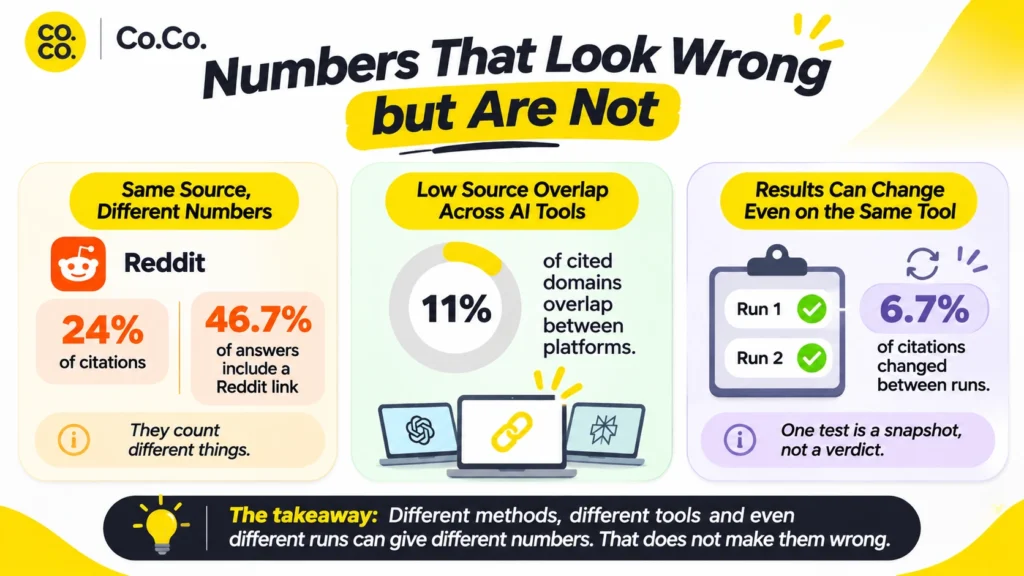
Some figures online seem to clash. Often they just count different things.
Reddit shows up as 24 percent in one source and 46.7 percent in another. The first counts citations. The second counts answers that include at least one Reddit link. They measure different things.
Source overlap looks wild too. Qwairy’s study of more than 669,000 citations found only 11 percent of cited domains overlap between platforms. See the Qwairy comparison. Every AI tool picks sources its own way, so a win on one does not carry over to another.
Even the same tool disagrees with itself. In the Discovered Labs test, 6.7 percent of citations changed between runs of the same question. One test is a snapshot, not a verdict.
Claims to treat with care
Here is where the guesswork lives.
Weighted tables are the biggest red flag. One site says relevance is worth 30 percent, placement 20 percent and domain authority 15 percent. Another gives citation frequency 35 percent and placement 20 percent. They do not match, and neither shows how it was measured.
Domain authority claims conflict too. One page cites a correlation of 0.61, another 0.18. Treat both as unverified.
A popular line says 92.78 percent of cited pages have fewer than ten backlinks. That sounds like proof that links do not matter. But most web pages have few backlinks anyway, so the number proves very little.
Other lines, like schema adding about ten percent or a secret list of trusted publishers, came from vendor pages with no source we could trace.
Even the number of factors changes by page. We found guides listing five, six, seven and nine factors. That alone tells you nobody is reading from an official list.
What this means for Indian businesses
Reports have described India as one of Perplexity’s biggest markets by traffic. Recheck the latest figure before you rely on it, since this changes quickly. If your customers use Perplexity, test it in both English and Hindi or Hinglish, because the pages it pulls can differ by language and wording.
According to COCO, this is also where local proof matters. A page that answers a real Indian customer’s question, with local prices, names and examples, beats a copy of a global guide. Our digital presence beyond social media guide covers why the basics on your own site come first.
A citation test you can run today
You do not need an expensive tool. Use this simple method, based on how Discovered Labs ran its study.
- Write ten questions your customers really ask.
- Run each question in Perplexity three times, since answers change.
- Write down every website that gets cited, and whether your page is among them.
- Search the same question on Google and note who sits on page one.
- Compare the two lists. Look at which pages get cited, how they are written, and how fresh they are.
- Check that PerplexityBot is allowed in robots.txt and that your firewall allows its published IP addresses.
- Repeat once a month and keep the results in a simple sheet.
Frequently asked questions
How does Perplexity decide which sources to cite?
Perplexity searches the live web, pulls candidate pages and cites the ones that best support its answer. It publishes no formula, so the exact weights are unknown.
Does Perplexity use Google rankings?
Perplexity does not say so. But in one controlled test, Google page one position predicted citations far better than publisher type or domain strength.
Does Perplexity respect robots.txt?
PerplexityBot does, according to Perplexity. Perplexity-User generally does not, because a person asked for the page.
Do backlinks matter for Perplexity?
The evidence is thin and mixed. Backlink counts alone do not explain citations, but Google visibility, which often depends on links, does appear to help.
How do I check if Perplexity cites my site?
Run your real customer questions several times and log the cited websites. No official Perplexity dashboard exists that we could find.
Should my experts write on LinkedIn or on our own site?
Publish the full piece on your company site first, then share it through personal profiles. Companies were cited more often than individual authors in the best test we found.
Final thoughts
Perplexity is not a box that hides a secret recipe and it is not a free for all either. Let Perplexity’s bots in earn your spot, on Google page one keep your pages fresh and clear and show up where people already trust the answers. Then test your questions instead of trusting a table of percentages.
According to COCO, the winners here will not be the people who chase a made up formula. They will be the people who build pages worth citing, and keep checking whether it works. If you want hel