Table of Contents
Summary
Topical authority comes from covering one subject so well, and so clearly, that readers and search systems start to trust you on it. This guide shows how to build it with a content cluster in five steps, from choosing a narrow topic to linking and reviewing every page. It shares case studies from Yello, Unic and a home décor site, an honest timeline, a simple check for pages that compete with each other, and a quarterly health scorecard. It also audits our own COCO blog cluster and shows the gaps we found. Finally, it explains why two popular AI citation statistics seem to disagree.
Key takeaways
- Pick one narrow topic you can prove from real experience, and finish that cluster before starting another.
- Build the pillar page first, then publish supporting posts one at a time, each owning one question.
- Check every new post against your existing pages so two of them never compete for the same question.
- Link the pillar and supporting posts both ways, link related posts sideways, and update older posts to link forward.
- Expect months, not weeks. Real case studies show results arriving between four and seven months after publishing.
- Review each cluster every quarter for coverage, links, freshness, intent overlap and indexing.
- Treat AI citation statistics with care, because two popular numbers come from different samples and methods.
Introduction
Most blogs publish plenty and own nothing. Fifty posts on fifty different subjects tell a reader, and a search engine, very little about what you do best. A content cluster fixes that. It puts everything you know about one subject in one connected place.
The clear answer: To build topical authority with a content cluster, pick one narrow subject you can speak about from real experience. Publish one pillar page that answers the big question. Add six to ten supporting posts that each answer one specific question, and link them together with plain, descriptive anchor text. Finish one cluster before you start another, and review it every quarter. Authority builds over months, so plan for patience.
If you want the background first, read our guide on what topical clusters are and why Google rewards them. This post skips the history and focuses on the build.
Why one strong cluster beats fifty scattered posts
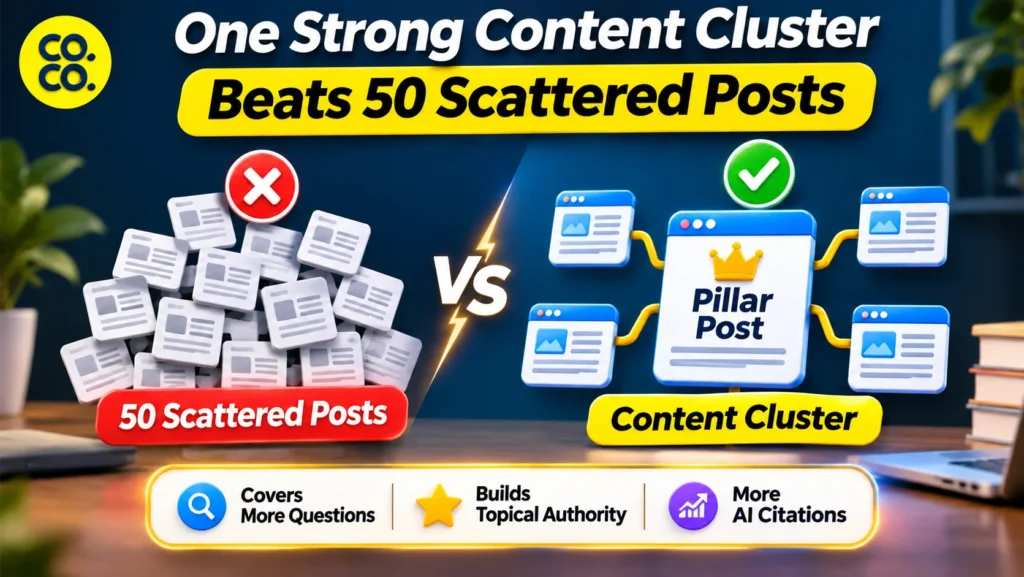
AI search has changed what a complete answer looks like. Google’s guide to generative AI search explains that one long question can split into several smaller searches behind the scenes. A site with one post can answer one of those small searches. A site with a connected cluster can answer several.
Search Engine Land’s topic cluster guide says Google’s June 2025 core update reinforced rewards for sites that cover a subject thoroughly, consistently and credibly. SEO consultant Matt Kundo makes a similar point in his AI Overviews playbook. He argues that one article cannot signal expertise, but a connected group of articles can. He also expects Google’s AI to judge whole content ecosystems more than single pages.
One warning before the steps. A blog category is not a cluster. As Passionfruit explains, categories help people find content, while clusters concentrate authority signals for machines. Ten posts in one category do nothing if they never link to each other and never cover distinct questions.
Step 1: Choose one narrow topic you can prove
A good cluster topic passes three tests. It connects to something you sell or want to be known for. You have real experience with it. And it splits naturally into at least six or seven separate questions.
“Marketing” is too broad. “Instagram content for jewelry brands” is the right size. ContentGrip warns that most teams start five clusters at once and end up with five unfinished ones. HubSpot’s topical authority glossary says the same thing in another way: spreading across several subjects before one matures dilutes the signal.
According to COCO, the best first topic is the one your team already explains out loud to clients every week. You will never run out of proof for it.
Step 2: Collect real questions before you write a single title
Do not brainstorm headlines at a desk. Collect questions from the places where customers actually ask them:
- Your Search Console queries.
- Enquiries that arrive by email, form or WhatsApp.
- Questions raised on sales calls.
- Comments and replies on your social posts.
- The “People also ask” box on Google.
Surfer’s topic cluster guide shows one way to group Search Console queries into related hubs. A simple spreadsheet works just as well. Give each question three columns: the question, what the searcher really wants, and the page that will own it. The rule is one question, one page. Single Grain notes that this map also gives writers a clear brief, which cuts duplicate drafts.
Step 3: Write the pillar page first
Writing supporting posts before the pillar exists is a common mistake, according to ContentGrip. Your pillar page should answer the main question in its first hundred words. After that, give each subtopic a short section that links to the deeper post. Add each link on the day that post goes live.
Be honest inside the pillar about what it does not cover. A reader who trusts that edge will trust the rest.
Step 4: Publish supporting posts one at a time
Each supporting post owns one question. It answers that question in the first paragraph, then adds proof that only you have, such as a number from real work, a mistake you saw or a screenshot. For a small team, one post a week is a healthy pace.
A simple check for posts that compete
- Before you write, search Google for your target question plus your own domain name and see which of your pages already appears.
- After publishing, open the Performance report in Search Console and look at that query. If two of your pages show up, they compete.
- Merge the weaker page into the stronger one, redirect the old address and fix the links.
A guardrail against going too far
Do not write a page for every tiny variation of a question. Google’s spam policies warn that generating many pages mainly to manipulate rankings can count as scaled content abuse. If two questions get the same answer, they get one page.
Step 5: Link the whole cluster with plain anchor text
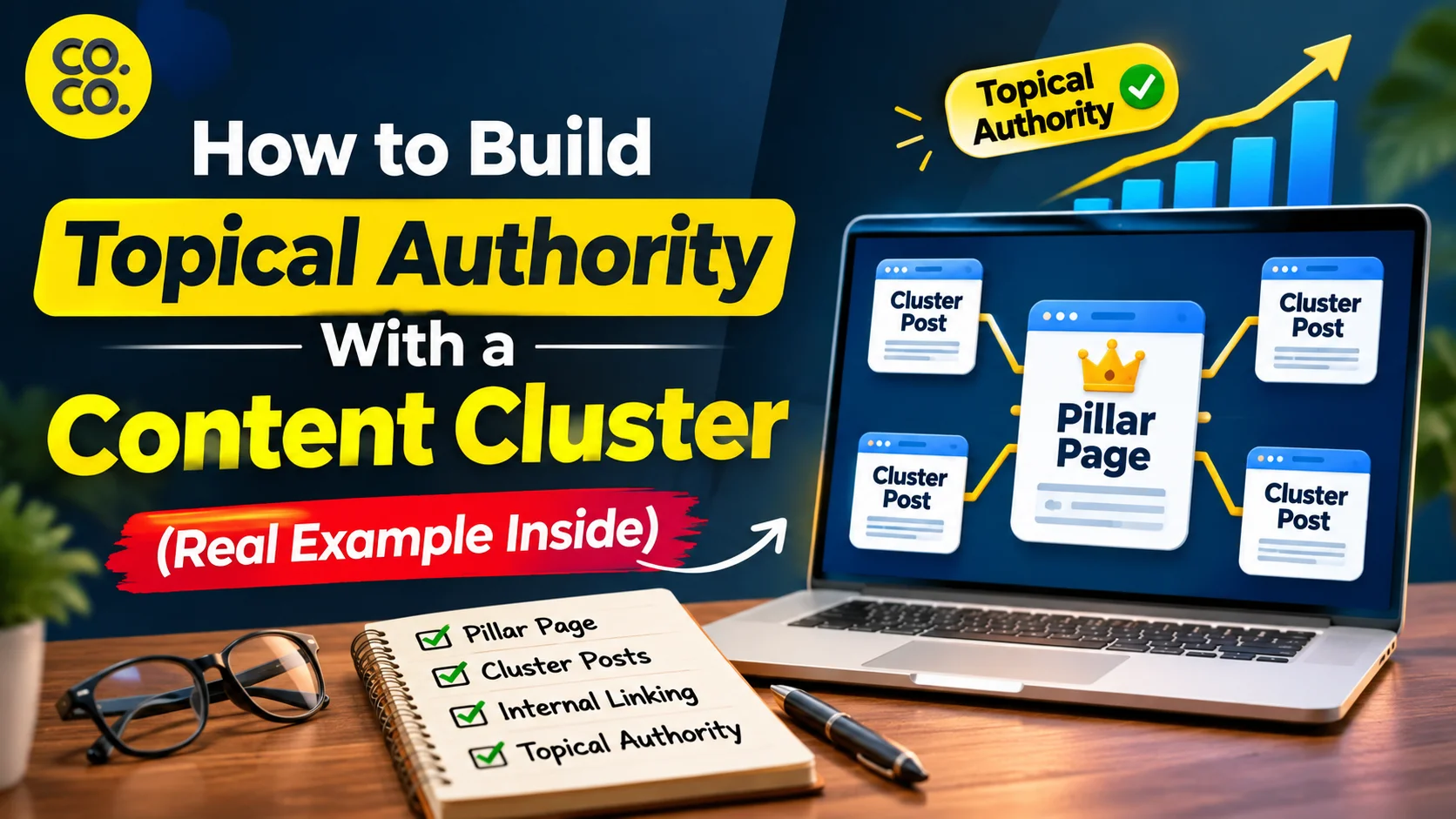
Links turn separate posts into a cluster. Follow these five rules:
- The pillar links to every supporting post.
- Every supporting post links back to the pillar.
- Related supporting posts link to each other.
- Anchor text describes the destination, such as “how to check keyword cannibalization”, never “click here”.
- Older posts get edited to link forward to newer ones.
Search Engine Land’s topic cluster guide says descriptive anchor text helps search engines understand what the linked page covers. Practical Ecommerce adds that subtopic pages should link to the pillar with the same or similar anchor text.
Rule five is the one most teams skip. New posts can link back to old ones easily. Old posts never link forward unless somebody goes back and edits them.
A real example: we audited our own cluster
We would not ask you to build a cluster without checking our own. Our recent SEO and AI search posts form a natural group: topical clusters (October 26), what Google wants from websites in 2027 (November 3), how Perplexity chooses sources (November 11) and why AI generated blogs fail to rank (November 20), plus our guides on landing pages that do not rank and on changing search behavior. In late November 2026 we looked at how they link to each other. Here is what we found.
- No pillar page yet. The group has good supporting posts but no single hub that ties them together.
- Links mostly run backward. Our newest post links to five related posts. Our older posts mostly point to service pages and not to each other.
- The cluster has gaps. We have strong pieces on AI search, but few on the measurement side, such as how to track what a cluster earns.
Our plan is simple. We will build one pillar page for this group, edit the older posts to link forward, and fill the measurement gap with new posts. We are not claiming traffic results yet. Once the cluster has had time to settle, we will add real Search Console numbers to this post.
According to COCO, an honest audit of your own site teaches you more than any template, because the gaps are always easier to see in a table than in your head.
What real case studies show
Three published examples give a useful range. Two come from companies that sell tools in this space, so read them with that in mind.
Yello. MarketMuse’s Yello case study reports that Yello doubled its organic blog traffic in six months. Its method was to identify clusters, plan posts for each query, build the pillar page, and then repeat one cluster at a time.
Unic. The agency’s pillar page write up covers two client clusters. Early on, not much happened. The pillar page for one cluster settled on page one for its main keyword about seven months after publishing. Organic traffic across one cluster rose more than 50 percent, and across another it rose more than 150 percent.
A home décor site. Link Whisper’s case study covers a WordPress site with more than 450 articles. After the pillar content and internal links were fixed, organic traffic rose 47 percent in four months. Average ranking positions improved 31 percent, and indexed orphan pages fell 84 percent. Link Whisper sells an internal linking tool, so treat the numbers as a vendor result.
The pattern is clear. Every example worked one cluster at a time, and every one needed months before the numbers moved.
A realistic timeline
This is our planning guide, built from the case studies above. It is not a promise.
- Months one and two: Collect questions, map the cluster and publish the pillar page.
- Months two to four: Publish one supporting post a week. Check indexing in Google’s Page indexing report and add links as pages go live.
- Months four to six: Run your first review. Merge posts that compete and fix any orphan pages.
- Months six to nine: Expect the pillar page to start moving. Unic’s pillar took about seven months.
- Every quarter after that: Refresh the pages that matter most.
If someone promises authority in thirty days, ask to see the case study.
The AI citation statistics that seem to clash
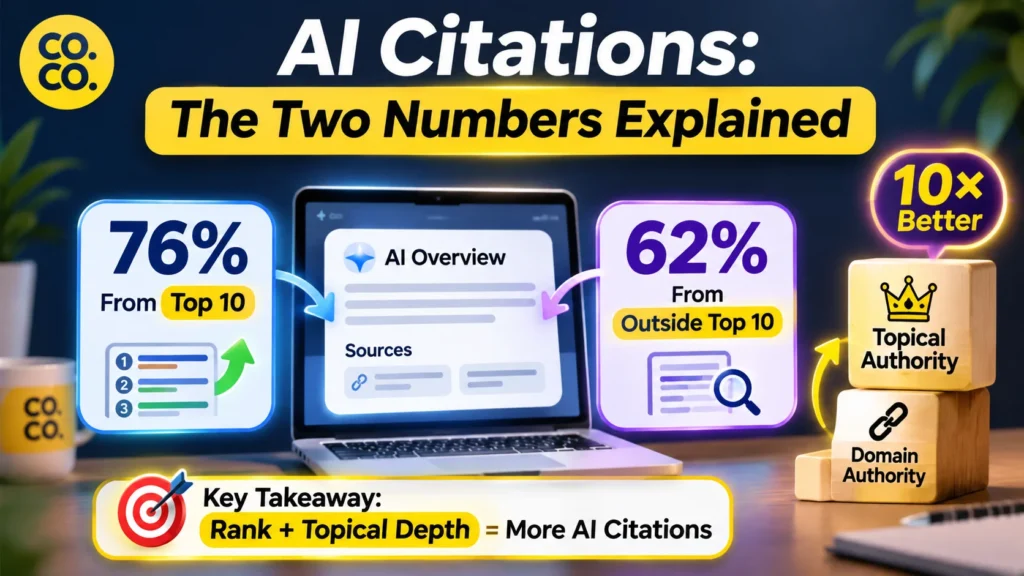
Two numbers circulate about how AI Overviews pick sources, and they look like they disagree. Kundo’s playbook says 76 percent of cited URLs come from the top ten organic results. Gabriel Bertolo of Radiant Elephant argues in his post on topical authority that AI Overviews pull 62 percent of citations from outside the top ten, because query fan out reaches deeper into the index. His post also claims topical authority predicts AI citations ten times better than domain authority.
Both can be true. Different studies use different keyword samples, dates and ways of counting a citation. The shared message is the useful part: ranking helps, and depth helps even when you do not rank first. Treat the ten times figure as an agency claim, not settled fact.
There is one more angle. A recent Search Engine Land column by Kevin Indig summarizes new research suggesting AI cites brands across many topics but recommends them only where they have built repeat topical authority. We read the summary and not the full study, so check the original before you quote it. For how one AI tool picks its sources, see our guide on how Perplexity chooses which websites to cite.
A cluster health scorecard for every quarter
Single Grain suggests tracking how many of a cluster’s queries earn impressions, clicks and AI citations at fixed checkpoints. Here is a simple version you can run in an hour.
- Coverage: How many of your mapped questions now earn impressions?
- Links: Does every page link to the pillar and to at least one sibling? Do any orphan pages remain?
- Freshness: When did you last update each page? Replace old numbers and show the new date.
- Intent: Do any two pages show up for the same query?
- Indexing: Is every cluster page indexed?
Anything that fails goes on next quarter’s to do list.
Mistakes that quietly weaken a cluster
Search Engine Land’s guide to clusters for AI search lists five common problems: poor internal linking, gaps in depth, the wrong content approach, failing to promote content and letting the cluster go stale. Here is what a weak cluster looks like in practice:
- Posts on the same subject with no pillar and no links between them.
- Shallow supporting posts that repeat the pillar in fewer words.
- Five clusters started and none finished.
- Publishing and then never sharing, so no one links to the pillar.
- A cluster left untouched for a year.
Where a small team should start
You do not need a content team to do this. Pick one service you sell. List the twenty questions customers asked you most this year. Group them, and choose one pillar and six to eight supporting posts. That is roughly ten weeks of weekly publishing. We suggest this size as a practical starting point, not a proven rule. Our content marketing service builds clusters this way for teams with limited time.
According to COCO, a small cluster that you finish and keep fresh beats a large plan that you abandon at post four.
Checklist before you call a cluster done
- Does the pillar page answer the main question in its first hundred words?
- Does every supporting post own one question that no other page owns?
- Does every page link to the pillar and to a related sibling with descriptive anchor text?
- Did you edit older posts to link forward?
- Is every page indexed, with a visible update date?
- Does every page contain proof that only your team could add?
- Do you have a quarterly review booked in the calendar?
Frequently asked questions
How do I build topical authority from scratch?
Choose one narrow subject, publish a pillar page, add supporting posts that each answer one question, and link them all together. Finish that cluster before starting another.
Should I build a cluster from old posts or start fresh?
Start with what you have. List your existing posts on the topic, merge the overlapping ones, choose or write a pillar, and add links. Then fill the gaps with new posts.
How do I know if two of my posts are competing?
Open Search Console and check the query. If two of your pages appear for it, they compete. Merge the weaker one into the stronger one.
How often should I update a cluster?
Review it every quarter. Update the pages that carry the most traffic or the most business value first, and show the new date.
Can a new website build topical authority?
Yes, but it takes patience. A new site has no history, so a small, finished, well linked cluster gives it the clearest chance to show focus.
Do I need paid tools?
No. A spreadsheet, Search Console and careful editing cover the basics. Tools save time on larger sites.
Final thoughts
Topical authority is not a trick. It is the result of choosing one subject, answering it properly, connecting your pages and keeping them current. The case studies took four to seven months to show results, and every one of them worked on one cluster at a time. That is the plan to copy.
According to COCO, the brands that win here are the ones that check their own work first, then fix the gaps. If you want a cluster mapped for your site, our team can walk through it with you. You can also read more on the COCO blog or get in touch.