Table of Contents
Summary
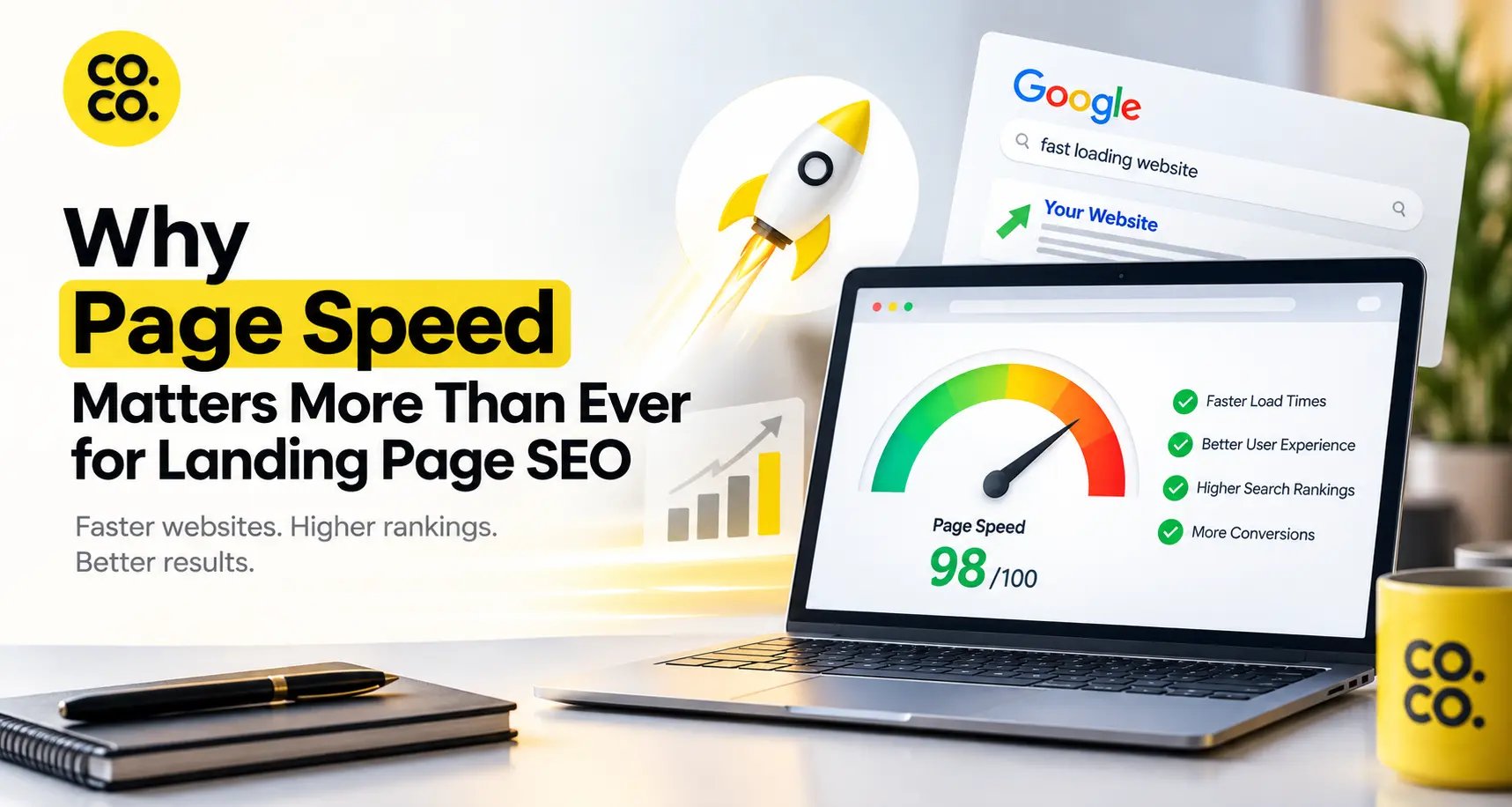
Page speed does not guarantee rankings, but it shapes how many visitors stay on your landing page. Google uses Core Web Vitals in its ranking systems, yet relevance still comes first. More than half of mobile sites fail the vitals, mostly on loading. Slow pages cost conversions, and heavy hero images, extra scripts and weak hosting cause most delays. This guide explains what Google really says, how field data differs from lab scores, why Indian audiences need phone level testing, and how to run a 15 minute speed check.
Key takeaways
- Speed is a modest ranking signal and a big conversion lever.
- Aim for LCP under 2.5 seconds, INP under 200 milliseconds and CLS below 0.1.
- Loading is the weak spot, since only 62% of mobile origins have a good LCP.
- Do not lazy load the hero image, and give it high fetch priority.
- Audit every script, because third party tags hurt INP.
- Lab scores can mislead. Check field data and test on real phones.
- Fix message match first, then speed, then trust.
Introduction
Picture this. You spend two weeks on a landing page. The headline is sharp, the offer is strong, and the ad brings real clicks. Then a visitor taps through on a phone, watches a blank screen for four seconds, and leaves. Your headline never got a single look.
That quiet loss is why page speed matters more than ever for landing page SEO.
The short answer: Page speed matters more than ever for landing page SEO because Google’s ranking systems use Core Web Vitals, more than half of mobile sites still fail them, and slow pages lose visitors before your message lands. Speed will not rescue weak content. It does protect every click you worked or paid for.
What Google really says about page speed
Let’s clear the hype first, because this topic has plenty of it.
Google says there is no single page experience signal, that its core ranking systems use Core Web Vitals, and that it will still show the most relevant content even when the page experience is poor. Google also warns that good scores in Search Console or third party tools do not guarantee top rankings. Read Google’s own words in its page experience documentation.
Google’s John Mueller described the signal in a similar way. He said it is more than a tiebreaker, but it does not replace relevance. Independent data agrees. Backlinko’s study of 11.8 million results found no link between load speed and first page rankings, while the top result had about 3.8 times more backlinks than positions two to ten. That study measured speed with older Alexa data, so treat it as one clue, not the final word.
What COCO says: Talk about speed with both hands. Speed is a modest ranking signal and a big conversion lever. Anyone who calls it the secret to number one is overselling it. Anyone who says it does not matter is ignoring their bounce rate.
The three numbers that define “fast”
Google measures speed with three Core Web Vitals. Think of a shop.
- Largest Contentful Paint (LCP) is how fast the shop door opens. Google wants it to happen within the first 2.5 seconds.
- Interaction to Next Paint (INP) is how fast the shopkeeper answers you. The good mark is under 200 milliseconds.
- Cumulative Layout Shift (CLS) is whether the shelves move while you reach for something. The good mark is below 0.1.
A page passes when three out of four visitors, measured at the 75th percentile, have a good experience. Your fastest visitor does not count for much. INP replaced the old FID metric in March 2024, so any guide that still leans on FID is out of date.
Why speed matters more now
Most of the web still fails
In the 2025 Web Almanac, 48% of mobile sites passed all three vitals, up from 44% the year before. The weak spot is loading. Only 62% of mobile origins had a good LCP, against 77% for INP and 81% for CLS. Secondary pages do better than home pages, at 56% against 45% on mobile, and most landing pages are secondary pages. Even so, the field is far from full. If your landing page passes, you beat a big share of the competition.
Paid and organic clicks land on the same page
Google builds Quality Score from expected click through rate, ad relevance and landing page experience, and it describes landing page experience as how relevant and useful your page is. Google does not publish a fixed load time rule there. One agency calls Core Web Vitals the best public proxy for that signal, not a direct input. So write “speed supports landing page experience,” and avoid promising that a three second rule exists.
What about AI search?
Google’s AI Overviews documentation does not list page speed as a citation factor. A 2026 Search Engine Land analysis of more than 107,000 pages, as reported by an agency, found only a weak link between LCP and AI Overview inclusion. A page that fails to load helps nobody, human or bot. But speed is not a magic key to AI citations, and you should not sell it that way.
According to COCO, AI visibility is a bonus of a well built page. Chase clear answers, trusted sources and reliable loading. Do not chase a speed score just to please a robot.
What a slow landing page really costs
Numbers make the case better than opinions, so here are the best ones.
Portent studied more than 27,000 landing pages from 20 sites. B2B lead gen pages that loaded in one second converted three times higher than pages that took five seconds, and five times higher than pages that took ten. For goal conversions, the rate sat near 40% at one second, 34% at two seconds and 29% at three. Portent also found that server and page setup now matter more than raw page weight. You can read the full Portent speed study yourself.
India has its own proof. redBus, a bus booking site based in India, raised sales by about 7% after improving its INP, and its INP improved by 72%. Read the redBus case study on web.dev.
One honest warning. The well known Deloitte and Google study linked a 0.1 second mobile gain to an 8.4% retail conversion lift, and Google and SOASTA found mobile bounce chances rose 32% as load time went from one to three seconds. Both are correlational. These studies show links, not proof of cause. Use them to decide where to look, then test on your own page.
Where landing pages lose speed (and what most guides skip)
The hero image
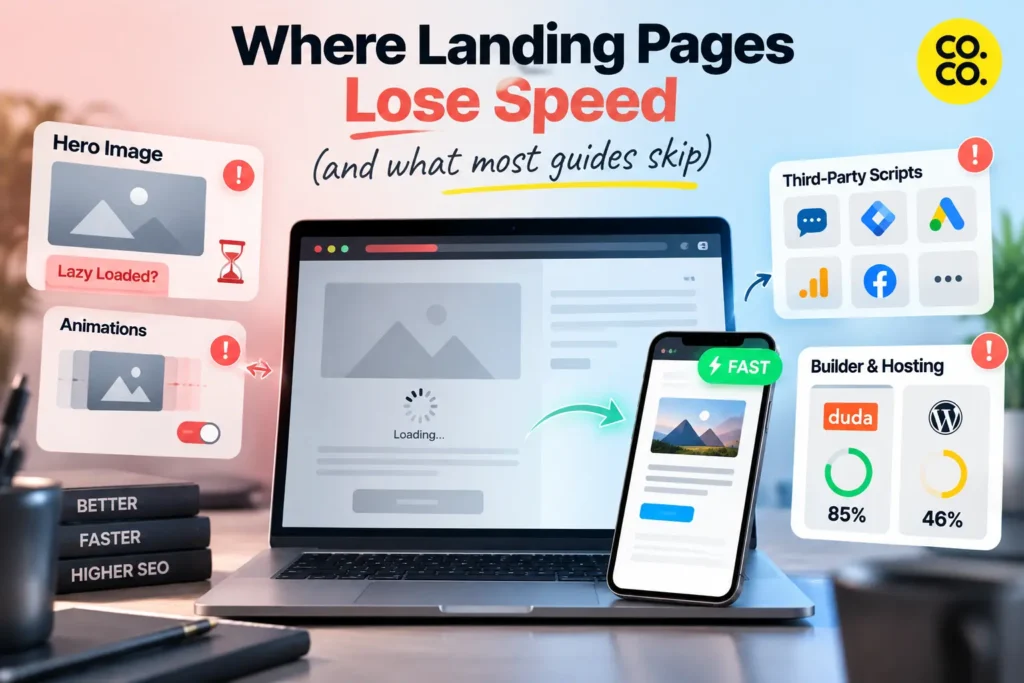
Most guides say “compress your images” and stop. The real story is more specific. On 76% of mobile pages, the LCP element is an image. Yet about 16% of pages still lazy load that image, and only 17% of mobile pages use fetchpriority high. Google Flights cut its LCP from 2.6 to 1.9 seconds with that single attribute. Check the Web Almanac performance chapter for the full data.
Fancy entrance animations can hurt too. Shopify’s developer guidance recommends removing the animation on the main image, because hiding it costs you the LCP credit.
Tags, chat widgets and pixels
Landing pages collect scripts like a fridge collects magnets. INP failures often come from long tasks, and third party tags such as chat widgets, ad scripts and tag managers compete with the visitor’s tap for the main thread. Portent suggests firing non critical Google Tag Manager tags on DOM Ready or Window Loaded.
According to COCO, every script on a landing page must earn its seat. If nobody opens a tag’s report, remove the tag.
Your builder and hosting
In November 2025 data, Duda sites passed Core Web Vitals about 85% of the time and WordPress sites about 46%. WordPress INP was strong at 85.89%, so its problem is loading, not responsiveness. On WordPress, look at hosting, caching and image handling before anything else.
Why your speed score can lie to you
A green Lighthouse score does not equal a fast experience for real people. Google grades you on field data. Field data comes from real Chrome users over a rolling 28 day window. That creates three traps.
First, a page gets no values if too few people visit it in Chrome. Google may fall back to group or origin level data. A brand new landing page often has no field data of its own. Real user monitoring can fill that gap for lower traffic URLs.
Second, Search Console mixes visitors from every location, so heavy traffic from a slow country pulls your numbers down. The CrUX dataset in BigQuery lets you split results by country and device. Use the Search Console Core Web Vitals help page to see what the report covers.
Third, improvements show up slowly because of that 28 day window.
What COCO says: For a new landing page, do not wait for the data. Open it on a mid range phone over a slow connection and watch it load with your own eyes.
Speed for Indian audiences
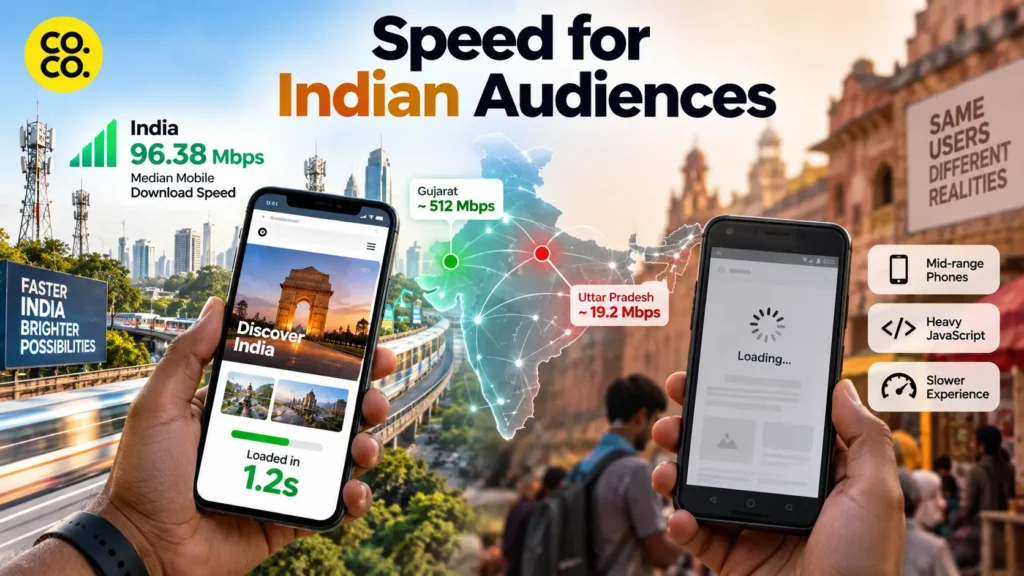
India’s networks look strong on paper. Ookla’s August 2024 data put India’s median mobile download speed at 96.38 Mbps, against 55.80 Mbps globally. But averages hide a lot. In Ookla’s August 2023 data, median speeds ranged from about 19.2 Mbps in Uttar Pradesh to about 512 Mbps in Gujarat. Some practitioners also note that many Indian users browse on mid range Android phones.
A fast network does not fix a slow phone. Heavy JavaScript hurts most on weaker phones, and that is where INP matters. The redBus result fits this picture.
According to COCO, test Indian landing pages for heavy scripts on mid range phones before you touch anything else. We call this a working view, not a proven rule. Public India specific pass rate data is still thin, so test your own audience.
Speed or message match: what comes first?
Google says relevance leads and page experience supports it. So fix things in this order.
- Message match. Your headline must match the ad or search that sent the visitor.
- Speed. Make the page open before the visitor gives up.
- Trust. Add proof, clear contact details and a simple form.
According to COCO, a fast page with the wrong message is just a fast miss.
A 15 minute landing page speed check
You do not need a developer for the first pass.
- Run PageSpeed Insights on the mobile tab. Read the field data first if it shows.
- Find the LCP element. It is usually the hero image or headline.
- Confirm the hero image is not lazy loaded, has fetchpriority high and fits the screen size.
- List every script on the page. Remove or delay anything you do not use.
- Add width and height to images so the layout stops jumping.
- Open the page on a mid range phone and tap every button.
- Retest after a few weeks, because field data updates slowly.
Myths to drop
You do not need a perfect 100 score. Google itself says good scores do not guarantee rankings. Old advice about FID, Flash and AMP no longer fits how modern landing pages work. And speed alone will not push a thin page to number one, since site performance rarely drives dramatic ranking changes on its own.
Frequently asked questions
Does page speed affect SEO for landing pages?
Yes, but modestly. Core Web Vitals feed Google’s ranking systems, and relevance still comes first. The bigger win is more visitors staying long enough to convert.
How fast should a landing page load?
Aim for an LCP under 2.5 seconds on mobile. Portent suggests a one to four second load time for goal conversions.
Does page speed affect Google Ads Quality Score?
Landing page experience is one of three Quality Score parts. Google defines it around relevance and usefulness, and speed supports it. Google does not publish a fixed load time rule.
Does page speed affect AI Overviews?
The evidence is weak. Google does not list speed as a citation factor, and one large analysis found only a slight link.
Why is my landing page slow on mobile?
The usual causes are a heavy hero image, too many scripts and weak hosting. Test on a real mid range phone to see it.
Final thoughts
Page speed will not carry a weak landing page to number one. It will stop a good page from wasting the clicks it earns. Fix message match first, make the hero image load early, trim your scripts, and test on the phones your buyers actually use.
What COCO says: Build the page for the person holding the phone, then let the metrics confirm it. If you want a landing page and content plan built around that idea, talk to the content marketing team at COCO.