
Table of Contents
Summary
A landing page can be well written and still fail to rank, and the real cause is rarely the content itself. This guide walks through the technical settings that quietly hide landing pages from Google, the common mismatch between page format and search intent, the fine line between a useful landing page and a thin doorway page, and a landing page specific trap tied to how builder tools handle indexing by default. It also covers a pattern common among Indian businesses, where reused city templates quietly suppress rankings, and ends with a five minute self audit any business owner can run before calling in outside help.
Key takeaways:
- Good content is necessary but never sufficient for ranking on its own.
- Many landing page builders set pages to noindex by default, which silently blocks organic ranking.
- A page can fail to rank simply because it answers a different kind of question than what searchers expect for that phrase.
- There is a real, checkable difference between a useful landing page and a thin doorway page.
- Domain wide issues, like other weak pages on the same site, can quietly suppress a well built landing page too.
- Reusing one landing page template across multiple Indian cities with minimal changes is a common and fixable ranking trap.
- A five minute self audit covering indexing, intent, and content depth reveals most ranking problems before any rewrite is needed.
Introduction
You wrote a strong headline. You built a clean page. The offer is clear and the design looks sharp. Then you check Google and your page is nowhere to be found.
If that sounds familiar, you are not alone, and the problem is almost never the writing itself.
The clear answer:
your landing page is not ranking because something underneath the good content is blocking it. That could be a technical setting that hides the page from Google, a mismatch between what your page offers and what searchers actually want for that phrase, content that reads as too thin to be useful on its own, or simply stronger competition already sitting on page one. Good content is the starting point. It was never the finish line.
The real reason good content still does not rank
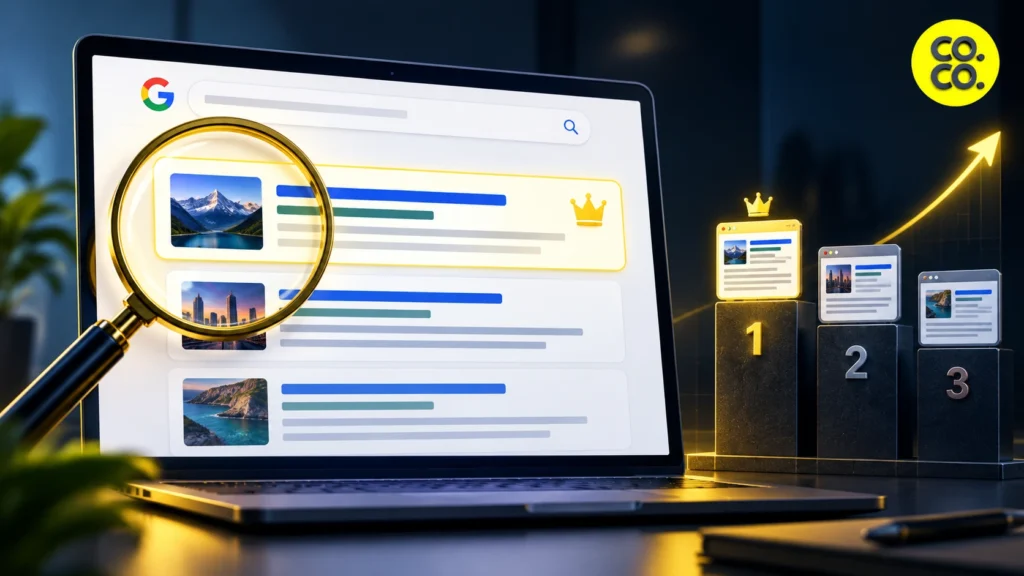
Here is a change in how you think that makes all the difference. Google does not look at your landing page. Wonder, is this good. It looks at your landing page and wonders is this better, than the pages that are already showing up for this search. Your competition is not an idea. It is a list of pages that you can see and study right now.
Before changing a single word on your page, open Google and search the exact phrase you want to rank for. Look honestly at what shows up. Are they long guides? Product pages? Comparison articles? That list tells you more about why your page is not ranking than any technical checklist ever will.
According to COCO, this is the very first step in every landing page project we take on. We study what already holds page one before we write a single sentence, because writing good content for the wrong format wastes the effort entirely.
Four real reasons your landing page is not ranking
Your page may be invisible to Google without you knowing
This is the most common and most overlooked cause for landing pages specifically. A noindex tag left on by accident, a robots.txt rule blocking the page, or a canonical tag quietly pointing to a different URL can all keep a perfectly good page out of Google’s results entirely.
Here is what makes this especially common for landing pages. Many landing pages are built using tools like Unbounce or Instapage for paid ad campaigns, and these builders often set pages to noindex by default. The idea is to stop a paid campaign page from competing with the main website for the same keyword. That setting makes sense for a pure ad campaign page. It becomes a real problem when the same page is also expected to rank organically, and nobody remembers to flip that setting off.
You can check this yourself in a couple of minutes. Open Google Search Console, go to the page indexing report, and search your landing page’s exact URL. If it says excluded by noindex tag, you have found your answer.
Google’s own Search Essentials guidelines explain exactly what a page needs to be crawled and indexed in the first place, and it is worth reading if you manage landing pages regularly.
Your page may be answering the wrong kind of question
Search intent mismatch is simple once you see it, and surprisingly easy to miss while you are deep in writing a page. If the top results for your target phrase are long educational guides, a short conversion focused page will struggle to compete there, no matter how persuasive it is. The reverse is just as true. If the top results are product pages, service pages, or sign up pages, a long blog style article will underperform for that same reason.
Search Engine Land’s breakdown of how search engines treat paid landing pages is a useful read here, since it explains how differently Google treats a conversion focused page compared to an informational one.
Your page may read as thin, even if it does not feel that way to you
Landing pages are designed to be short. That shortness can make them look thin in Googles eyes. I think it is important to tell the difference, between a useful landing page and what Google calls a doorway page. A doorway page is made mostly to rank then to send visitors elsewhere. It has very little real content of its own.
Ask yourself three honest questions. Does this page say anything meaningfully different from your other pages, or did you mostly copy and reuse a template? Would a visitor learn something real here, or is it just a headline and a form? Could this page be confused with dozens of other pages on your own site that look almost identical?
If you answered no to the first two, that is worth fixing before anything else. Google’s Helpful Content System guidance explains this standard directly, and it applies to landing pages just as much as blog posts.
You may simply be competing against stronger domains
Sometimes the page itself is fine, but it sits on a site with a thin backlink history, or alongside other pages on the same domain that are genuinely low quality. Google does weigh engagement signals like click through rate, bounce behavior, and return visits, and a pattern of weak pages elsewhere on your site can quietly drag down a good page too.
According to COCO, this is exactly why we audit the whole domain before touching a single landing page. Fixing one page in isolation rarely works if the rest of the site is sending the opposite signal.
The landing page trap almost nobody talks about
Of everything above, the noindex by default setting deserves its own spotlight, because it is the single biggest gap in how this topic usually gets explained.
Most advice about ranking problems is written for websites in general, then applied loosely to landing pages without accounting for how differently they are built. A landing page built for a paid campaign, left on a builder’s default settings, was often never meant to rank organically in the first place. Business owners get frustrated chasing a content problem that does not exist, while the actual fix is a single settings change away.
If you want your landing page to do both jobs well, convert paid traffic and rank organically, that decision needs to be made on purpose, not left to a tool’s default behavior. This is the kind of detail our content marketing and SEO work is built around catching early, before it quietly costs a client months of invisible traffic.
Why this shows up so often for Indian businesses
Search behavior in India is unusually tied to location, and that creates its own version of this problem. A business that builds one landing page template and reuses it across multiple cities, changing little more than the city name, ends up with pages that look and read almost identically. Google’s systems are built to notice that pattern, and it can quietly suppress all of those pages rather than rewarding any single one.
One commonly repeated figure claims that over seventy percent of Indian businesses rank for keywords that bring traffic but very little real business value. I was not able to trace that number back to its original source, so treat the exact figure with some caution. What does hold up across several independent case studies is the underlying pattern it describes, ranking for the wrong kind of keyword, and building pages that attract visits without attracting the right visits.
According to COCO, every city or service variant of a landing page deserves its own real content, its own local detail, and its own reason to exist, not a find and replace job on a single template. That one habit alone fixes a surprising share of ranking problems we see in Indian businesses specifically.
The five minute audit you can run right now
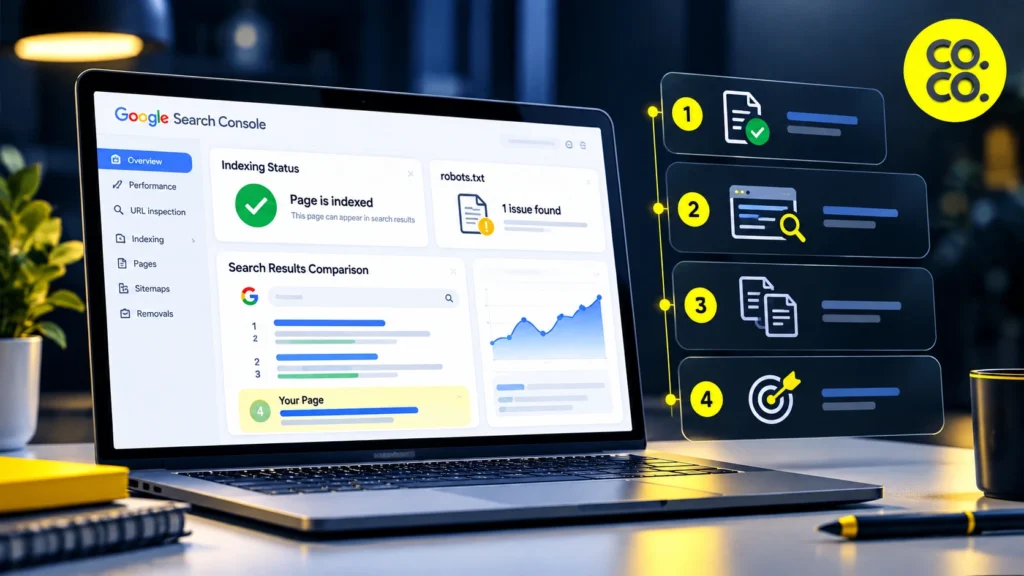
Before calling anyone for help, you can check most of this yourself. Start with indexing. Open Google Search Console and confirm your landing page is actually indexed, not excluded by a noindex tag or blocked by robots.txt. Next, search your exact target phrase and compare your page honestly against whatever already ranks on page one. Then look at your own page with fresh eyes and ask whether it offers something genuinely different from your other pages, or whether it reads like a template with the details swapped out. Finally, reread your page as if you were the person searching, and ask whether it actually answers what they were looking for, not just what you wanted to say.
Most ranking problems reveal themselves somewhere in those four checks.
Frequently asked questions
Why is my landing page not showing up on Google?
The most common reasons are a noindex tag or robots.txt rule blocking the page, a mismatch between your page and what searchers expect for that phrase, or content that reads as too thin to rank well on its own.
Can a landing page be noindexed by accident?
Yes, and it happens often. Many landing page builders set pages to noindex by default to avoid competing with a business’s main SEO pages. If you want that same page to rank organically, you need to turn that setting off deliberately.
What is the difference between a landing page and a doorway page?
A legitimate landing page offers real, useful content that matches what a visitor is searching for. A doorway page exists mainly to rank for a search term and then push visitors elsewhere, usually with little genuine content of its own, and Google treats this as a violation of its spam policies.
Does word count affect landing page rankings?
Not directly. A short page can rank perfectly well if it matches search intent and offers real value. The length only becomes a problem when it crosses into thin or templated content with nothing meaningful to say.
How do I check if Google is even crawling my landing page?
Open Google Search Console, go to the page indexing report, and search your page’s exact URL. It will tell you clearly whether the page is indexed, and if not, exactly why.
Final thoughts
Good content was never the finish line. It is the starting point that everything else gets built on top of. If your landing page is not ranking despite genuinely good writing and design, the answer is almost always sitting in one of four places, a technical setting, a mismatch with what searchers want, content that reads as thin, or stronger competition you have not studied closely enough.
According to COCO, the businesses that fix this fastest are the ones willing to check the boring, technical details first, before assuming the content itself needs another rewrite. If you would rather have a second set of eyes run this audit for you, our SEO and content team at COCO can walk through it with you directly.