
Table of Contents
Quick answer
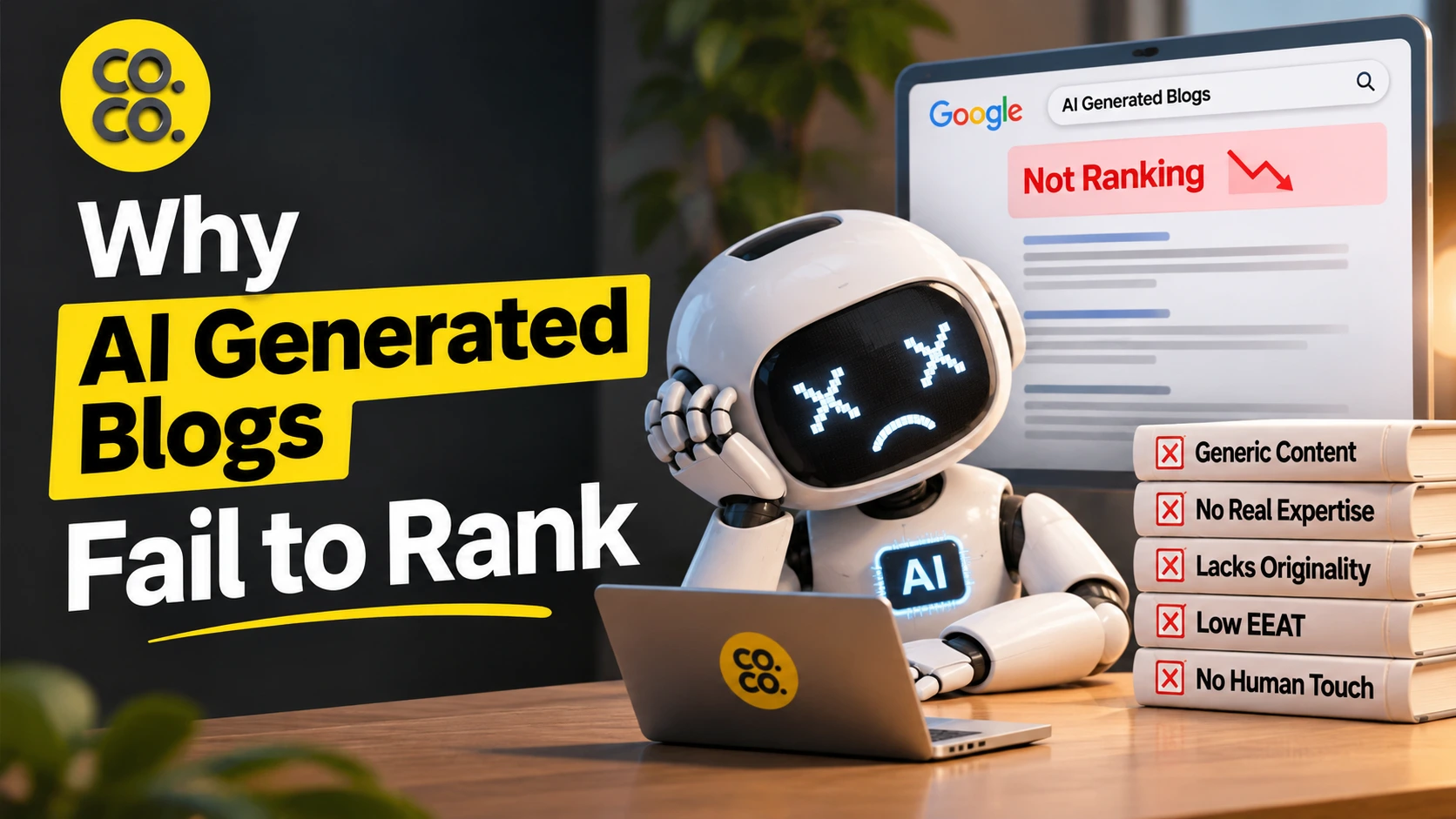
Most AI generated blogs fail to rank because they say what every other page already says. Google doesn’t ban AI writing. It ignores pages that add nothing new, and it acts on sites that publish lots of such pages. In the studies below, heavy AI pages earned fewer impressions, and untouched AI content on new sites faded after a short boost. The fix is simple to say and harder to do. Use AI for the first draft, then add real experience, real facts and a clear point of view before you publish.
Why this question keeps coming up
You paste a keyword into an AI tool. Two minutes later you have a clean, tidy article. You publish it, wait a few weeks and see almost nothing in Search Console.
That feels unfair, because the article reads fine. The problem is that “reads fine” is not the bar. Google has to choose one page for the searcher, and your page has to give it a reason. If your post is a blend of the top ten results, it gives Google no reason.
This post shows what the research says, why many AI blogs stall, and how to edit an AI draft so it earns its place. If your page has a different problem, such as a good page that still won’t rank, read our guide on why a landing page is not ranking even with good content.
Does Google ban AI written blogs?
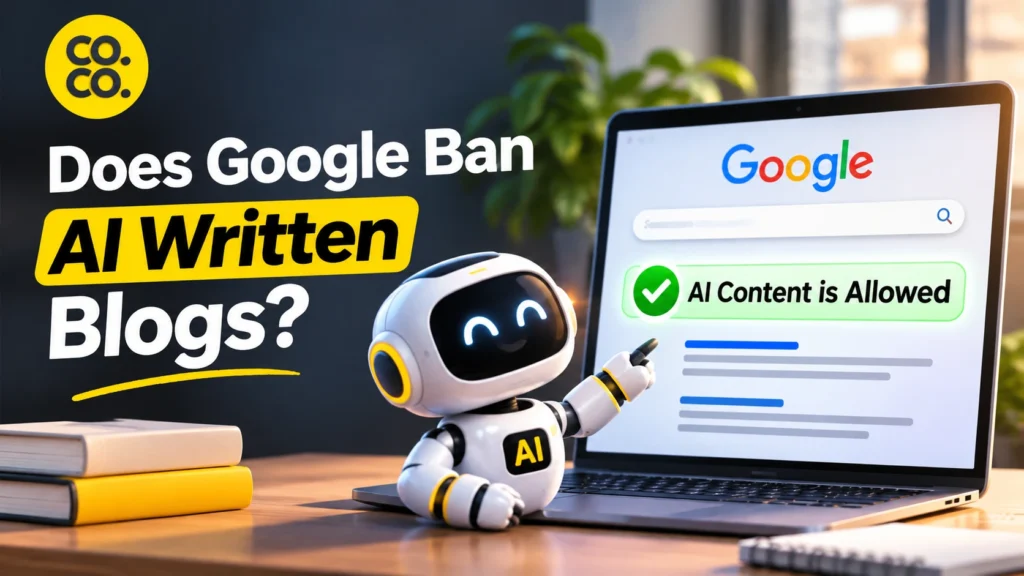
No. Google’s guidance on generative AI content says AI can help you research a topic and add structure to original content. It also warns that using AI tools to generate many pages that add no value for users may break the scaled content abuse policy. developers.google.com
Google’s spam policies define that abuse as many pages generated mainly to manipulate rankings instead of helping users. Notice what Google is targeting. It targets volume without value, whoever or whatever wrote the pages. A person who writes 500 hollow pages faces the same risk as a tool that writes them.
What the big studies found
Three studies get quoted a lot. Read together, they tell a clear story.
Ahrefs looked at pages ranking in June 2026. In positions 1 to 3, 5.3% of pages scored as fully AI written, and pages with under 50% AI text made up 82.2% of top three results. Pages with low or moderate AI content got 2 to 3 times the impressions of pages with high or very high AI content. Ahrefs says this shows correlation, not proof of cause. Its main explanation is that heavy AI use often goes along with weaker content, such as repeated common knowledge and missing firsthand experience. ahrefs
Semrush checked 42,000 blog pages. Human written content held the number one spot about 80% of the time, while AI content held it about 9 to 10% of the time. From position 5 downward the gap is narrow, and the most common way teams work is hybrid, with a human leading and AI assisting. semrush
Why the numbers look like they disagree. Ahrefs says fully AI pages can reach the top 3. Semrush says humans dominate position 1. Both can be true. They used different detection tools, different page samples and different ways to label a page as AI. A detector gives a probability, not a verdict, so treat every percentage as a rough guide. The shared message is the useful part: AI pages can rank, and the very top still leans toward pages with human judgment behind them.
The boom and bust pattern
The saddest stories involve a quick win followed by a slow fade.
SE Ranking ran a blunt test. It put 2,000 AI articles on 20 brand new websites, generated in one click with no edits, no internal links and no images. About 71% of those pages were indexed within 36 days. Then, around early February 2025, the share of pages in Google’s top 100 dropped from 28% to 3%. Recovery did not happen within 16 months, and the team did not recommend AI as the only method. One fair note on accuracy: the write up says “no traffic”, but its own figures show 1,381 clicks over the period. The real lesson is a short boost, then a steep drop, not zero. seranking
The same team also edited six AI assisted posts by hand and published them on its established blog, and three ranked in the top 10 over a year later. Same tool, very different result. The difference was human work and a site Google already trusted. seranking
SEO researcher Lily Ray saw the same shape at a bigger scale. Among 220 or more sites using AI content platforms, 54% lost at least 30% of their peak organic traffic, 39% lost 50% or more, and 22% lost 75% or more. The typical path was fast page growth, a traffic peak within about 3 to 6 months, and then a steep decline. searchenginejournalSubstack
If a vendor shows you only the peak, ask what happened a year later.
COCO’s take: use AI like a junior researcher, not a publisher
According to COCO, the question that matters isn’t “AI or human?” It is “who is accountable for this page?” AI is a fast way to gather ideas, outline a topic and write a rough first pass. It is a poor way to decide what your brand believes. Here is how we see it.
- An idea comes before words. A post needs a point to make before it needs a draft. AI can’t tell you what your brand stands for.
- Fewer, stronger posts beat more, weaker ones. Ten posts that each carry a clear idea do more for your brand than a hundred that blur together.
- A person owns every claim. If nobody on your team would stand behind a sentence in a meeting, it shouldn’t go live.
- Results decide, not output. We judge content by what it brings back: enquiries, leads and rankings that hold up months later. The number of posts published tells you very little.
That’s why we treat AI as a junior researcher on the team. It works fast and needs a senior person to check its work. It is also why our content marketing service starts with the idea, not the draft.
Seven reasons AI blogs fail, and what to do about each
1. The post repeats the average.
An AI tool learns from existing pages, so its default answer is the common one. If your post covers the same points in the same order as ten other pages, Google has no strong reason to pick yours.
Fix: Before you write, list what the top results already say. Then decide what you can add that they don’t, such as a number, a mistake you saw, or a clear opinion.
2. It has no firsthand proof.
AI can’t visit a client, run a test or take a screenshot. Ahrefs lists missing firsthand experience as a common weakness in basic AI content.
Fix: Add one thing that only your team knows. The section on proof below shows how.
3. It targets the wrong intent.
A searcher who types “why is my AI blog not ranking” wants a diagnosis. If your post gives a history of AI writing, they leave.
Fix: Answer the question in your first 100 words, then go deeper.
4. You wrote five posts about one idea.
Tools make it easy to create “AI content strategy”, “content strategy with AI” and “how to use AI for content strategy”. Those compete with each other. One audit describes five mediocre pages ranking between 15 and 30 instead of one strong page near the top. Our post on topical clusters explains how to organise related pages so they support each other.
Fix: Give each page its own purpose and its own searcher. Merge the rest. averi
5. You published too much, too fast, on a young site.
Ahrefs notes that scaled AI content on low authority domains may get crawled in a burst and then dropped from the index. Authority still matters.
Fix: Publish fewer posts and put more work into each. Earn links and mentions along the way. ahrefs
6. Nobody checked the facts.
AI tools can state a wrong number in a confident voice. Google now says plainly that fact checking AI text is critical (more on that below).
Fix: Check every statistic, date and quote against its original source.
7. The page has no point of view.
Content with no opinion reads like a brochure. Readers bounce, and nobody links to a brochure.
Fix: Take a side. Say what you would do and why.
What your Search Console is telling you
Before you rewrite anything, look at how Google treats the page. Google’s Page indexing report shows which pages it has crawled and indexed, and which it hasn’t. Different symptoms point to different causes.
“Discovered, currently not indexed.” Google found the page but hasn’t crawled it yet, often because it postponed the crawl to avoid overloading the site. If you published many pages at once, this is common. Publish at a calmer pace, link to the page from your strongest posts and check that it deserves a crawl. support.google.com
“Crawled, currently not indexed.” Google crawled the page but chose not to index it. Google says this is common and not always a problem, and for an important page it suggests the URL Inspection tool. If the page is important and keeps landing here, the content may be too close to pages already in the index. Add original material or merge the page into a stronger one. support.google.com
Indexed, but almost no impressions. Google kept the page and shows it to almost no one. Check your intent match and your title. Ask whether another page on your own site covers the same ground.
Impressions rose, then fell. This is the boom and bust pattern. Look at your newest pages as a group. If they share one template and a thin angle, improve or remove the weakest ones.
Indexed, ranking on page two or three. You are close. Add depth, proof, images that explain something, and links from related posts.
Proof only your team can add
This is where you beat any AI tool, because AI can’t fake it. Here are five questions to answer before you start writing. Ask your client, your team or yourself.
- What happened the last time someone tried this, and what went wrong?
- What real number can you share, such as a date range, a count, or a before and after?
- What would you tell a friend not to do?
- Can you share a screenshot, a photo or a short quote from a customer?
- What surprised you?
Local details help a lot, because general tools tend to miss them. A dentist in Pune thinks about WhatsApp enquiries, rupee pricing and GST invoices. A tool trained on global pages thinks about none of that. Put those details in and your page reads like it was written by someone who does the work.
How to edit an AI draft so it earns its place

Treat the AI draft as raw material. Here is a simple order of work.
- Set the angle first. Write one sentence that says what your post adds. If you can’t, don’t publish yet.
- Cut the fluff. Remove warm up paragraphs and filler phrases. Your first lines should help the reader.
- Add your proof. Use your answers from the five questions above.
- Check every claim. Open the source and confirm the number, the date and the wording. Remove anything you can’t verify.
- Rewrite the voice. Read it aloud. If you would never say a sentence to a client, change it.
- Add structure that helps. Use clear headings, short paragraphs and a direct answer near the top.
- Add links with a reason. Link to your own related posts, and to the primary studies you mention.
- Add a human name. Show a real author with a short bio.
Information gain is the idea behind this whole process. It means how much new material a page adds beyond what already ranks. An SEO writer has linked it to a Google patent granted in June 2022. Google hasn’t confirmed it as a ranking factor, so treat it as a useful test, not a rule. The test asks one thing: if someone deleted your page, would the web lose anything? searchengineland
Check the facts and the fine print
On October 1, 2026, Google added lines to its guidance explaining that generative models don’t retrieve facts and can produce errors, and it says manual fact checking is critical before publishing. The review now explicitly covers title elements, meta descriptions, structured data and image alt text. The edit doesn’t announce a ranking change or a new penalty. PPC Land covered the change in detail.
So your checklist should include the small fields people skip. In WordPress, open Rank Math and read your SEO title, your description, your schema and your image alt text. Check that each one is accurate and says something real about the page.
Google also suggests that you consider telling readers how the content was made. A short note at the end of a post does that, and readers tend to trust it.
What this means for AI search
AI answers pull from pages too, so quality matters there as well. Ahrefs checked 1.9 million links cited in AI Overviews. Pages that mixed AI and human work made up 87.8% of citations, against 71.7% of the general web, while purely human pages made up 8.6% of citations, against 25.8% of the web. That shows a link between production method and citation, not proof that AI Overviews favor AI authors. Teams with a strong process may simply produce clearer, fresher pages. somethinginc
The takeaway is practical. Use AI to work faster, then use your own judgment to make the page worth citing. To see how one AI search tool picks its sources, read our post on how Perplexity chooses which websites to cite. To understand why people now type longer questions into chat tools, read how search behavior is changing because of AI chat tools. For a wider view of Google’s expectations, see what Google wants from websites in 2027.
Quick checklist before you hit publish
- Does the first section answer the searcher’s question?
- Does the page add one thing the top results don’t?
- Did you include proof from real work?
- Did you check every number against its source?
- Does the post have its own purpose, with no overlap with another page on your site?
- Do the SEO title, description, schema and alt text all tell the truth?
- Does a named person stand behind it?
- Did you link to related posts and to the sources you used?
If any answer is no, fix it first. Speed is not the goal here. A strong page is.
FAQ
Does Google penalize AI generated content?
Not for the tool alone. Google’s guidance targets pages made at scale that don’t help users. Weak AI pages usually fail because they add nothing new.
Can AI content rank on page one?
Yes. In Ahrefs’ data, some fully AI pages reached the top 3. Most top pages had far less AI in them, though.
Why does my AI content get no impressions even though it reads well?
It likely matches what other pages already say, so Google has no reason to show it. Check Search Console for indexing status first.
How do I fix AI content that isn’t ranking?
Add proof from real work, check the facts, sharpen the angle, merge overlapping posts and improve the metadata.
Does publishing a lot of AI content hurt my site?
It can. The studies above show boom and bust patterns on sites that scaled fast. Fewer, stronger posts are the safer path.
Will AI content show up in AI Overviews and tools like ChatGPT?
It can, especially when a human has improved it. Clear answers, accurate facts and original material help.
How we made this post
The COCO content team read the studies linked in this post, wrote the explanations in plain language and checked each number against its original source before publishing. Every statistic links to where it came from, so you can verify it yourself.
Where to start this week
Pick your five weakest posts. Run each one through the checklist. Improve two, merge two and delete one. That small step teaches you more than another ten raw drafts will.
According to COCO, the best AI content plan is a smaller one: fewer posts, each with a real idea and a person behind it. Need help turning a pile of AI drafts into pages that deserve to rank? Browse our services, read more on the COCO blog, or talk to the team and we will look at your content with you.
Sources and further reading
Ahrefs: Google doesn’t punish AI content, Semrush: does AI content rank well, SE Ranking: AI content experiment, Lily Ray in Search Engine Journal, Google: using generative AI content, Google: spam policies, Google Search Console: Page indexing report, PPC Land: Google’s October 1 update, Ahrefs data on AI Overview citations, via Something Inc.